

When launching a new software product, teams often fall into one of two traps: (1) Over-engineering an enterprise architecture before gaining a single customer; or (2) Cutting reckless technical shortcuts that require a full system rewrite as soon as traffic picks up.
At MaxStack, we navigate this dilemma using our core philosophy: “Stack in Layers” — designing software that matches your immediate business reality while providing clean upgrade paths for the future.
The “Build It and They Will Come” Fallacy
Imagine a scenario all too common in the startup world. A founding team raises a pre-seed round and immediately hires a fleet of engineers to build a revolutionary B2B SaaS platform. They decide that to be “future-proof,” they must adopt a Microservices architecture. They spin up Kubernetes clusters, implement event sourcing with Apache Kafka, establish complex CI/CD pipelines, and use GraphQL federation across five different specialized services.
Fast forward eight months: The engineering team has burned through 60% of the runway just setting up infrastructure and debugging service discovery. The product finally launches, but the initial user feedback reveals that the core value proposition doesn’t resonate. They need to pivot, but changing a single data model now requires updating three different microservices and migrating an event store. The architecture that was supposed to make them agile has paradoxically paralyzed them.
This is how over-engineering kills early-stage projects. The team optimized for a scale (millions of users) they hadn’t yet achieved, sacrificing the one thing they actually needed: iteration speed.
The Flaw of the Monolithic Upfront Build
When inspiration strikes, the instinct is often to plan for massive scale: complex microservices, Kubernetes clusters, intricate billing tiers, and dozens of dashboard screens.
The real-world consequence:
- 6 to 9 months time-to-market: Market dynamics shift before the first user ever logs in. The longer you wait to ship, the longer you operate on assumptions rather than data.
- Hidden technical debt: Engineering time is wasted building and maintaining features nobody uses. Every line of code is a liability that must be maintained, tested, and secured.
- Inflated cloud bills: Complex infrastructure consumes valuable runway before achieving product-market fit. Running idle clusters of services costs thousands of dollars a month, bleeding capital that should go to marketing and customer acquisition.
The 3-Layer Architecture Roadmap
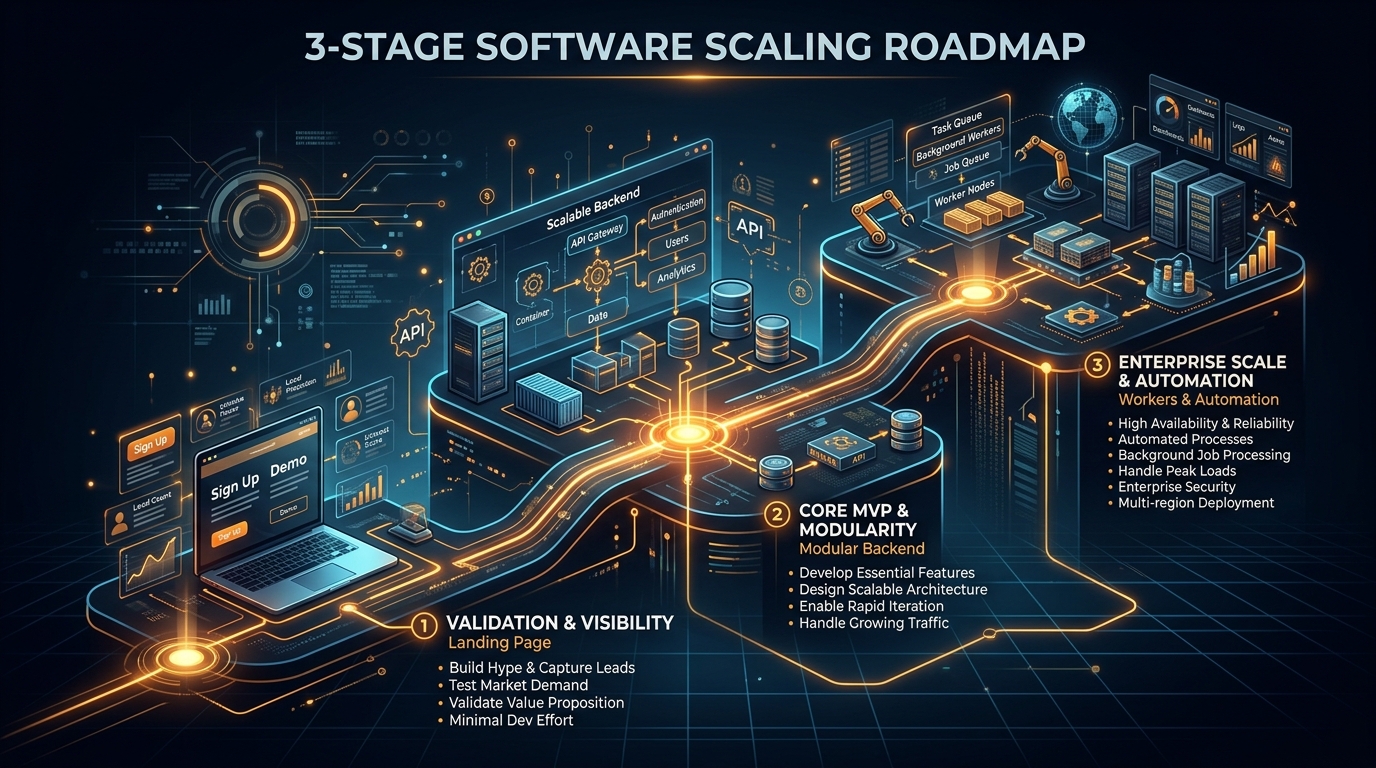
The “Stack in Layers” framework keeps capital lean and only invests in deeper complexity when customer traction justifies it. You do not build Layer 2 until Layer 1 proves successful. You do not build Layer 3 until Layer 2 is bursting at the seams.
Layer 1: Validation & Lead Generation (1–2 Weeks)
- Goal: Validate market demand and capture initial interest before writing complex application code.
- Technology: High-performance static site built with Astro SSG (LandingX), integrated with lightweight lead capture (like Typeform or a simple serverless function) and pre-order payment links via Stripe.
- Advantage: Launched in days with near-zero infrastructure overhead.
- The Metric to Move: Conversion rate on the landing page, email signups, or actual pre-sales. If you cannot get 100 people to give you their email address based on the value proposition, building a multi-tenant backend will not save you.
Layer 2: Core MVP & Retention Loop (4–8 Weeks)
- Goal: Deliver the single core value proposition that solves your user’s primary pain point. Do not build secondary features yet.
- Technology: A clean, modular monolith backend with a relational database (PostgreSQL) through Build4You. Clear separation between business logic, data access, and API controllers.
- What Clean Layer 2 Code Looks Like:
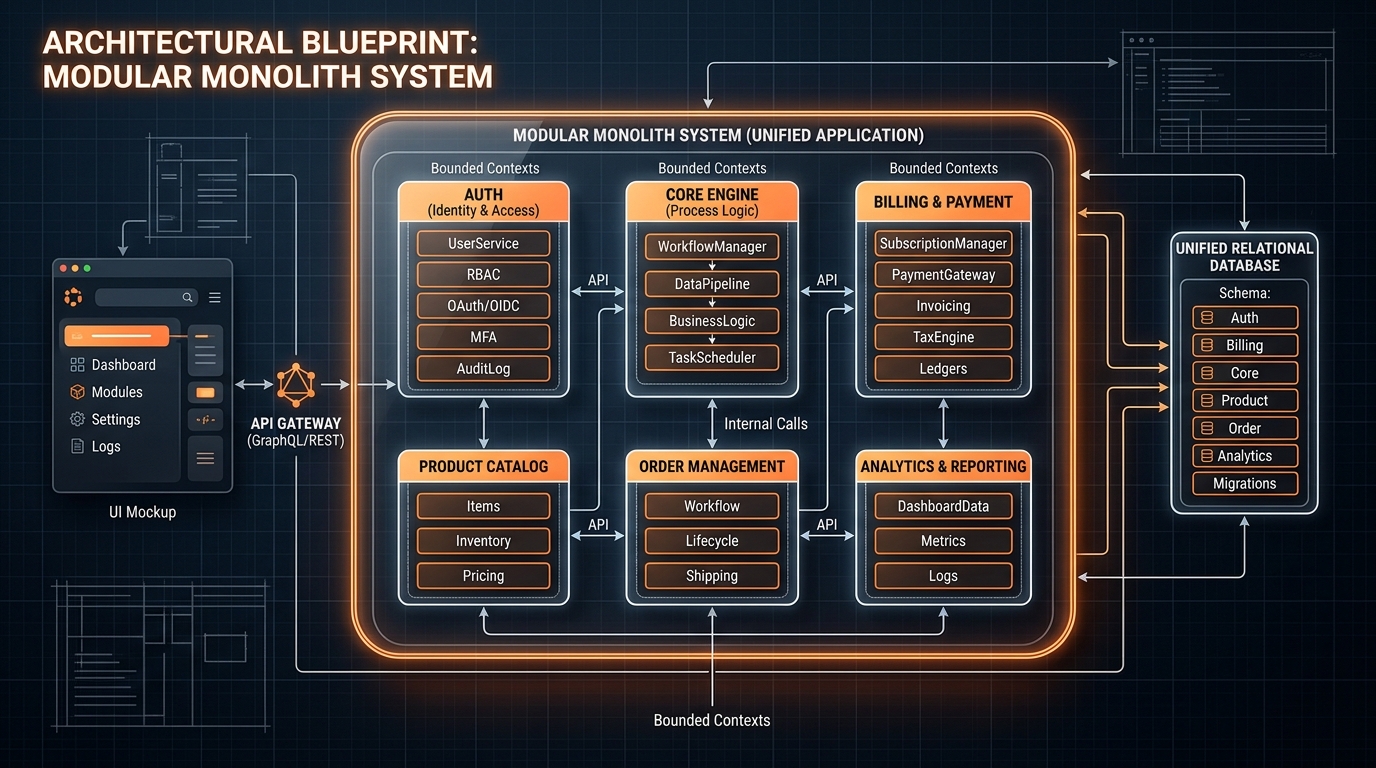
- Modular Monolith: Instead of separate services, use bounded contexts within the same codebase (e.g., separating
Billing,Users, andCoreApplogically, not physically). - Database Schema: Use simple, strict foreign keys. Rely on database-level constraints. Implement soft deletes (
deleted_attimestamp) instead of complex archiving mechanisms. Do not over-index prematurely. - Synchronous Operations: Avoid message queues unless absolutely necessary. A user signs up? Send the welcome email synchronously in the request lifecycle (or use a simple background job table).
- Modular Monolith: Instead of separate services, use bounded contexts within the same codebase (e.g., separating
- Advantage: Easily supports the first 10,000 active users with rock-solid stability and zero throwaway code.
Layer 3: Scale, Automation & Enterprise Operations (Growth Stage)
- Goal: Automate workflows, scale infrastructure to handle spikes, and integrate enterprise ERP systems.
- Technology: Transition specific high-load bounded contexts into background job workers or event queues (e.g., Redis + BullMQ). Integrate enterprise business management with TailorX, and launch companion mobile apps via MobileX.
- Advantage: You are now scaling because you have to, funded by actual revenue and proven user retention.
Metrics, Signals, and Triggers: When to Move Layers
How do you know it is time to move from Layer 1 to Layer 2, or Layer 2 to Layer 3? Rely on data, not boredom.
Layer 1 → Layer 2 Triggers:
- You have achieved your pre-sale target or waitlist size.
- The manual process (e.g., concatenating emails in a spreadsheet) is breaking down and taking more than 10 hours a week.
- Users are demanding to log in and manage their own state.
Layer 2 → Layer 3 Triggers:
- Database CPU: Your PostgreSQL database is consistently hitting 70%+ CPU during peak hours despite query optimization and indexing.
- Background Processing: You have tasks (like generating heavy reports or processing images) that are causing web requests to timeout.
- Team Size: Your engineering team has grown beyond 15 developers, and stepping on each other’s toes in the monolith is becoming a daily occurrence (triggering the need to carve out microservices for organizational, not just technical, reasons).
Negotiating with Stakeholders for the “Full System Now”
One of the hardest parts of engineering leadership is pushing back against non-technical stakeholders (founders, sales, or investors) who want the “full system now.” They see competitors with dozens of features and assume you need parity to launch.
The Negotiation Playbook:
- Highlight Opportunity Cost: Explain that every feature built before launch delays time-to-market. “We can build the custom analytics dashboard, but it will push the launch back by 4 weeks. Can we launch without it and see if users even stick around first?”
- Phase the Roadmap: Don’t say “no.” Say “Yes, in Phase 2.” Show them a visual roadmap where the MVP contains the core loop, and the “full system” features are scheduled immediately after based on user feedback.
- Use the “Fake Door” Test: If sales insists a feature is mandatory, put a button for it in the Layer 2 MVP. When users click it, show a modal saying “This feature is coming soon! Vote to prioritize it.” If nobody clicks it, you just saved months of engineering.
Layer Transition Checklist
Before graduating to the next layer, ensure you have checked these boxes:
Ready for Layer 2 (From Layer 1)?
- Value proposition is validated with real user actions (emails/payments).
- Core user loop is defined (what is the ONE thing they do in the app?).
- Database schema is drafted with strict normalization.
- CI/CD for a single monolith is set up.
Ready for Layer 3 (From Layer 2)?
- Product-market fit is established (high retention, growing MRR).
- Performance bottlenecks are identified via APM (Application Performance Monitoring).
- Slow queries are optimized; adding hardware (vertical scaling) is no longer cost-effective.
- Clear domain boundaries exist in the code to safely extract a service or worker.
| Layer | Business Objective | Time to Ship | Core Stack |
|---|---|---|---|
| Layer 1 | Market Validation | 1 – 2 weeks | Astro SSG · Edge CDN · Forms |
| Layer 2 | Core MVP & User Loop | 4 – 8 weeks | Modular Backend · PostgreSQL |
| Layer 3 | Scale & Operations | 2 – 4 months | ERP Integration · Mobile · Workers |
Build the right layer at the right time
Smart software development is knowing what to say no to today. You don’t need a distributed microservice cluster to test a value proposition. But what you do build, build with clean abstractions and modular code so that your next layer stacks seamlessly on top.
Partner with MaxStack
At MaxStack, our motto is Build Smart, Grow Together. We don’t just write code; we help founders and product leaders chart a lean, scalable technical roadmap that protects their runway and accelerates growth.
We specialize in guiding businesses through these transitions cleanly. Whether you need a high-conversion Layer 1 site with LandingX, a solid Layer 2 backend with Build4You, or complex enterprise ERP integrations in Layer 3 via TailorX.
Have a product concept ready to build? Consult with our engineering team today.

Comments & Discussion
0Your email address will not be published.
No comments yet. Be the first to share your perspective!