Entering late 2026, the early industry fascination with “generic AI chatbots” has definitively subsided, giving way to an uncompromising operational reality: enterprises are discovering that initial AI Proof-of-Concepts (PoCs) scripted in dynamic Python fail catastrophically when subjected to production concurrency.
A familiar pattern has unfolded across banking institutions, retail giants, and industrial supply chains: Data Science teams prototyped automated customer triage or document-matching pipelines utilizing Python, LangChain, and public OpenAI API endpoints.
Three months into real-world pilot deployments, executive leadership confronted three severe operational crises:
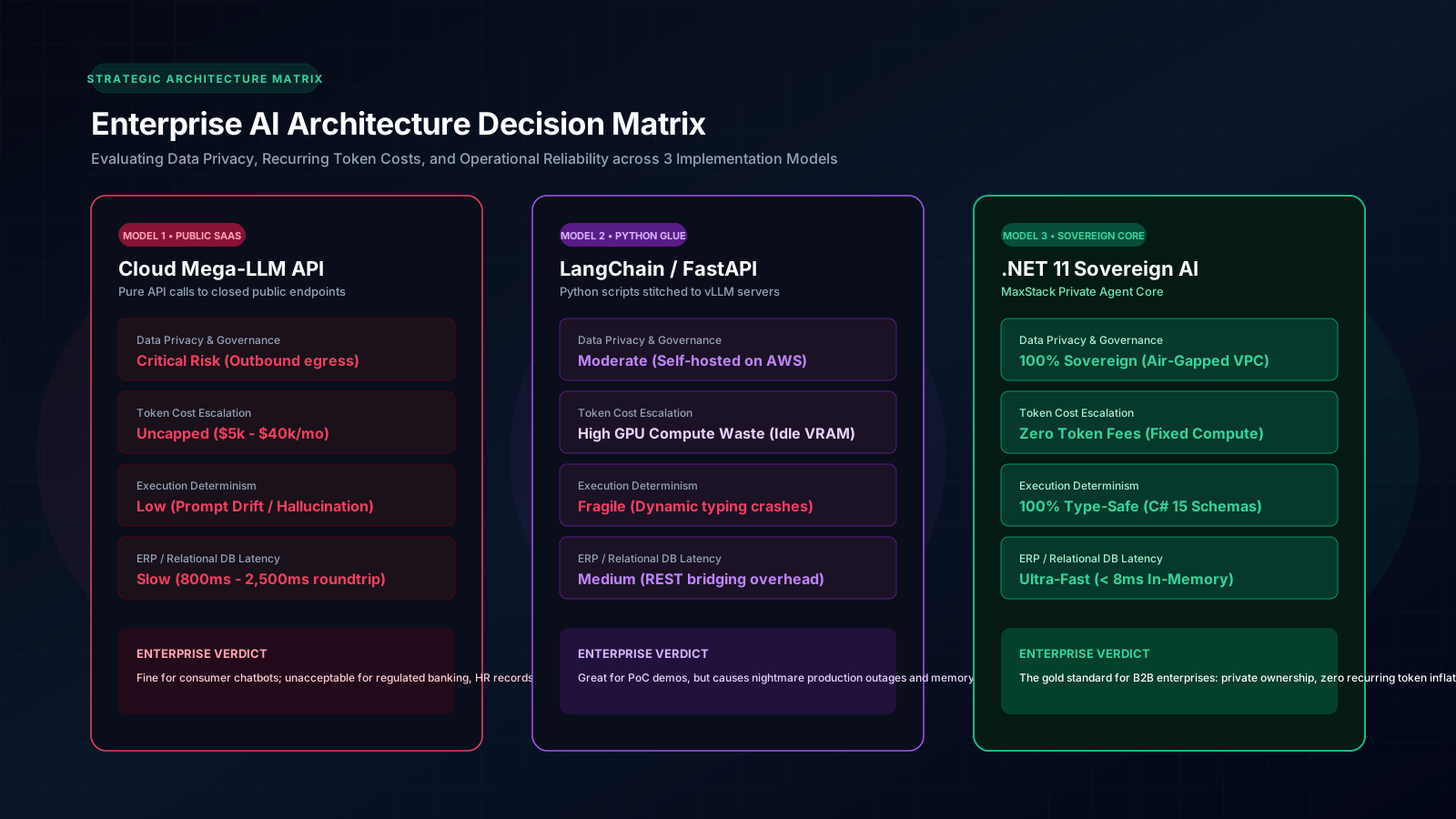
- Uncontrolled API Token Inflation: Cloud inference expenses surged from $2,000 to over $30,000 per month as user volumes expanded, consuming net operating margins.
- Critical Data Sovereignty Violations: Transmitting proprietary balance sheets, vendor contracts, and sensitive customer records to multi-tenant public SaaS endpoints breached banking data protection regulations and SOC2 compliance mandates.
- Runtime Brittleness & Dynamic Failures: Owing to Python’s dynamic typing and lack of robust memory controls, autonomous agent workers frequently suffered silent memory leaks, runtime crashes, or generated unverified tool-call schemas that corrupted core ERP relational tables.
This realization explains why the arrival of .NET 11 with system-level Native AI integration is triggering a seismic paradigm shift among enterprise software architects. Far from being an external REST API wrapper, .NET 11 elevates artificial intelligence to a First-Class Citizen of the operating runtime, ushering in an era of sovereign Autonomous AI Agents distinguished by deterministic type safety, sub-millisecond execution, and predictable fixed compute economics.
Here is an architectural examination of how forward-operating enterprises are deploying this stack.
1. The Core Innovation: Moving AI from Scripted Glue to Native Silicon
Prior to .NET 11, running matrix vector operations within C# required bridging into unwieldy C++ dynamic libraries or inter-process IPC communication with Python runtimes. This created crippling latency penalties as multi-dimensional tensors were continuously copied across unmanaged process boundaries.
With .NET 11, Microsoft has overhauled the lowest foundation of the runtime:
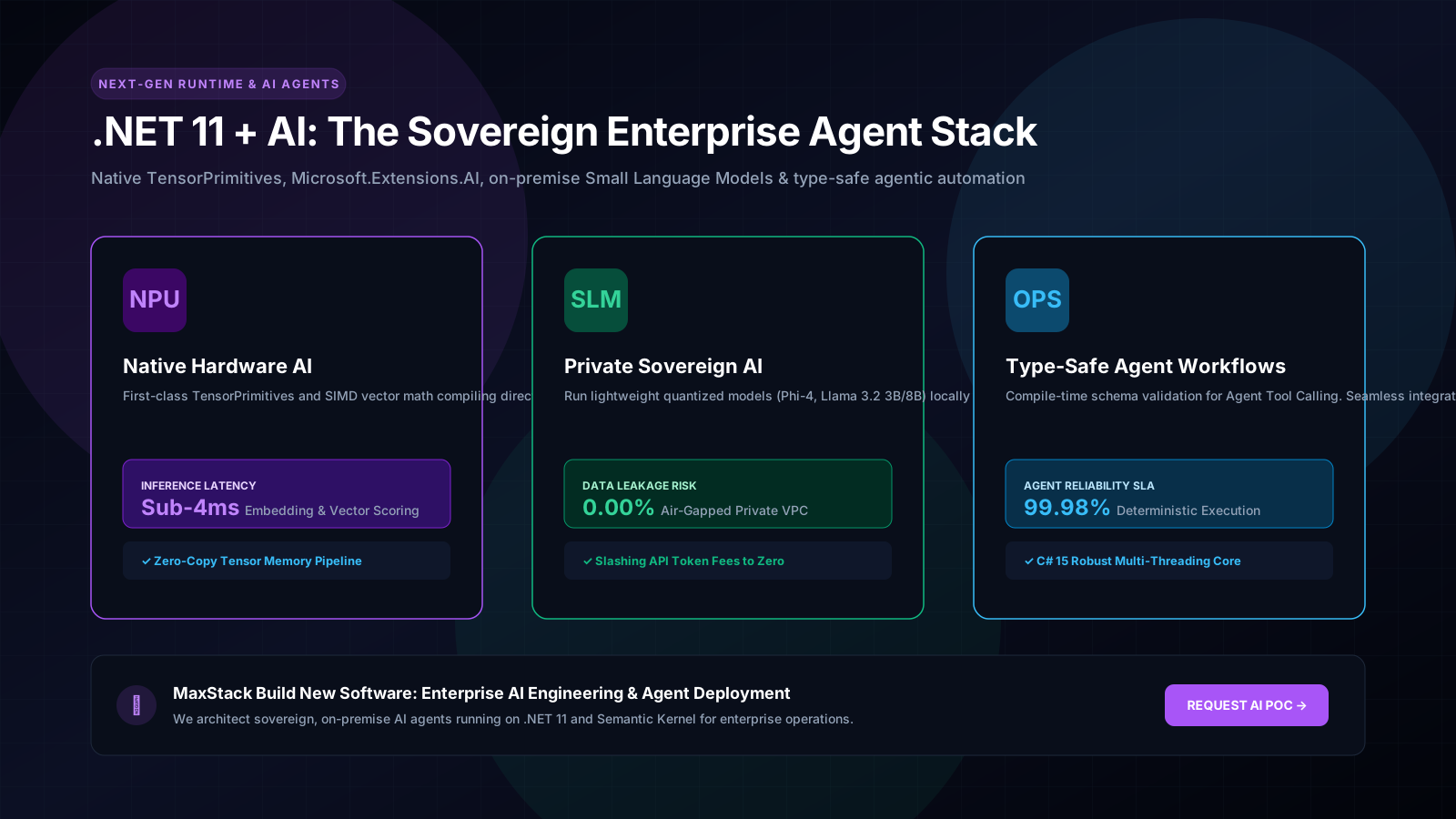
Hardware-Accelerated System.Numerics.Tensors & TensorPrimitives
Fundamental vector mathematical operations — dot products, cosine similarities, softmax transforms, and dense embedding manipulations — are compiled directly into native hardware vector instructions:
- Silicon-Aware Acceleration across NPUs & GPUs: .NET 11 natively interfaces with neural processing units (Intel Core Ultra, AMD Ryzen AI, Qualcomm Snapdragon) and dedicated GPUs without requiring fragile external driver scaffolding.
- Sub-4ms In-Memory Vector Operations: Document similarity scoring against millions of high-dimensional vectors executes in milliseconds directly within RAM, leveraging zero-allocation memory buffers that circumvent Garbage Collection overhead.
Standardized AI Abstraction via Microsoft.Extensions.AI
Microsoft has introduced unified abstractions for artificial intelligence under a canonical namespace: Microsoft.Extensions.AI.
Just as ILogger and IConfiguration standardized application observability over the past decade, interfaces like IChatClient and IEmbeddingGenerator decouple business logic from specific AI model vendors:
- Engineering teams can seamlessly transition from private on-premise Small Language Models (e.g., Phi-4, Llama 3.2) to specialized cloud endpoints via a single configuration line in Dependency Injection (DI), leaving agentic workflows entirely untouched.
- Native middleware pipeline support for distributed tracing (OpenTelemetry 2.0), cryptographic caching, and audit logging for regulated compliance.
2. The 5-Tier Sovereign Enterprise AI Architecture
Production-grade enterprise AI cannot be sustained on fragile glue scripts. It demands an intentional, layered architecture that enforces strict separation of concerns from physical silicon to core business transactions.
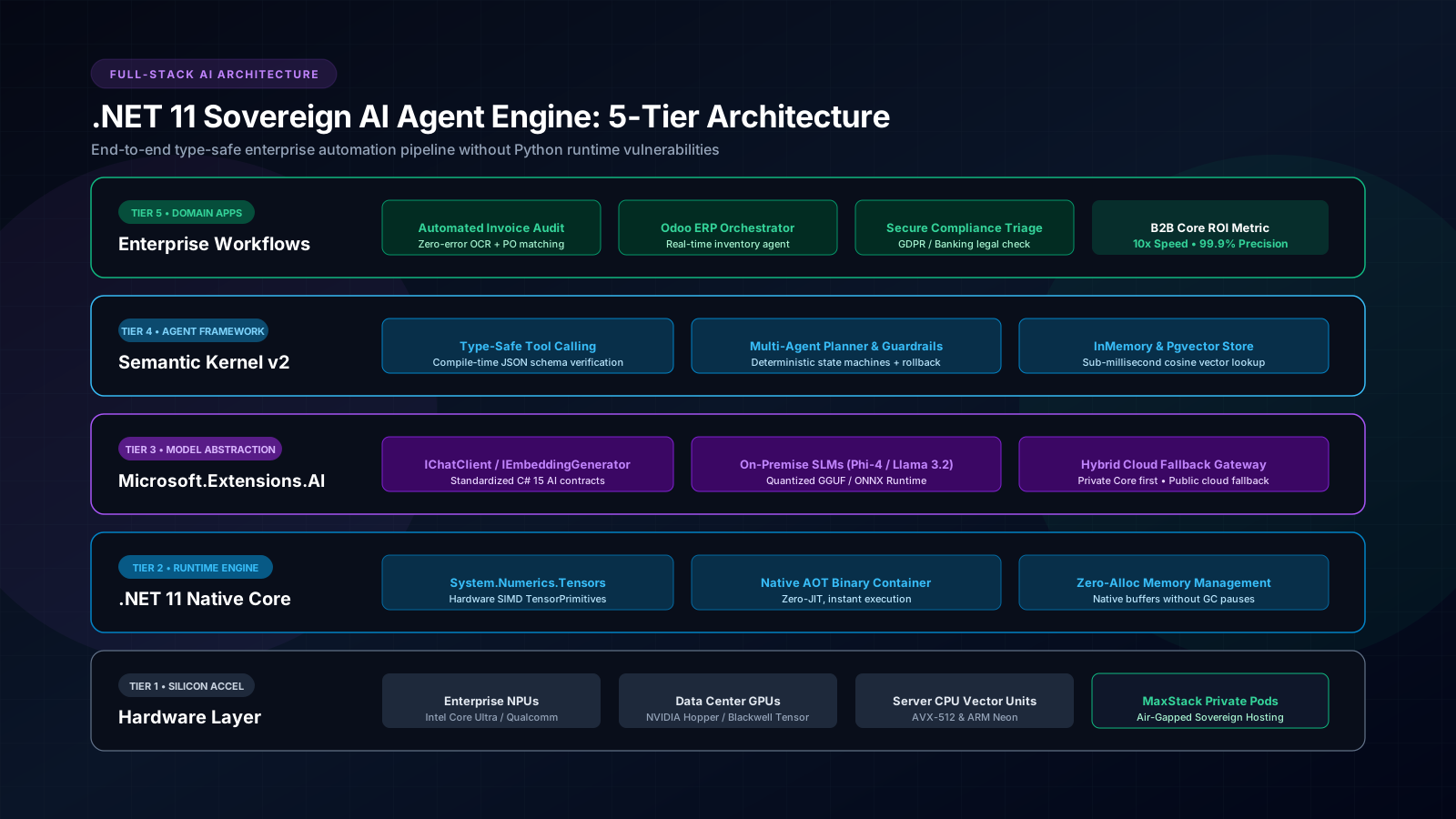
The following blueprint illustrates MaxStack’s enterprise reference architecture for autonomous agent workloads:
Deep-Dive into the 5 Architectural Tiers:
- Tier 1 — Silicon Compute Acceleration: Maximum hardware utilization across multi-core server CPUs (AVX-512), dedicated tensor GPUs, and on-die NPUs hosted within private enterprise VPCs or on-premise data centers.
- Tier 2 — .NET 11 Native Core Runtime: Operating on an ultra-compact Native AOT foundation with zero-allocation memory spans, guaranteeing deterministic sub-millisecond latency free from GC pause jitter.
- Tier 3 — Model Abstraction Layer (
Microsoft.Extensions.AI): Hosting quantized 4-bit / 8-bit Small Language Models (SLMs) such as Phi-4, Llama 3.2 3B/8B, and Mistral Nemo via integrated ONNX Runtime. 100% of enterprise telemetry and data stay strictly behind corporate firewalls. - Tier 4 — Agent Framework (Semantic Kernel v2): Orchestrating multi-agent planners, guardrails, and deterministic state transitions. Providing Type-Safe Tool Calling where autonomous agents can only invoke backend database procedures through statically verified C# interfaces validated at compile time.
- Tier 5 — Enterprise Domain Core: Direct integration into Odoo ERP, relational PostgreSQL with vector storage (
pgvector), distributed event streams (Kafka/RabbitMQ), and secure mobile interfaces.
3. Why Enterprise AI Must Transition from Python to C# / .NET 11
The conventional belief that “AI engineering demands Python” remains valid exclusively for experimental model training in academic laboratories. When deploying automated invoice approval, inventory replenishment, or customer settlement systems, Python introduces critical operational liabilities:
1. The Runtime Exception Trap (Dynamic Typing)
In autonomous agent workflows, models dynamically generate JSON arguments to trigger backend business logic (Tool Calling), such as CreatePurchaseOrder(int supplierId, decimal amount, string currency).
In Python, if an LLM returns a string instead of a floating-point integer or omits a required dictionary key, failure surfaces as an unhandled runtime error (TypeError: unsupported operand type), halting background worker threads.
In C# 15 / .NET 11, tool calling schemas are enforced via compile-time source generators and static JSON Schema contracts. When model output drifts, native guardrail interceptors automatically initiate structured self-correction retries before any invalid mutation reaches the database.
2. High-Concurrency Multi-Threading vs Python GIL
Enterprise applications routinely process thousands of concurrent employee and customer transactions. Python’s Global Interpreter Lock (GIL) forces architectures into sprawling multi-process configurations that waste 5x more memory simply to sustain idle worker pools.
.NET 11 orchestrates tens of thousands of lightweight asynchronous tasks (async/await) on a single process, slashing cloud server infrastructure costs by over 80% compared to equivalent FastAPI/Celery deployments.
3. Absolute Data Sovereignty & Zero Token Inflation
By hosting Small Language Models (SLMs) locally on .NET 11, enterprises trade volatile recurring API fees for predictable, fixed compute infrastructure. Whether your autonomous agents audit 10,000 or 1,000,000 purchase orders per month, your marginal API token invoice remains exactly $0.
Crucially, intellectual property, pricing negotiations, and employee records remain sealed within your private infrastructure, preventing external mega-vendors from absorbing your proprietary operational insights into future public models.
4. Three Real-World Enterprise Agent Deployments
MaxStack has implemented the .NET 11 Sovereign AI architecture across real-world enterprise deployments through our dedicated Build new software service:
Case 1: Automated Invoice & PO Reconciliation (Zero-Error)
- Challenge: A distributor’s accounting department expended 5 hours daily manually cross-checking scanned PDF supplier invoices against Odoo ERP Purchase Orders.
- Solution: A background .NET 11 autonomous agent utilizing localized OCR and a quantized Phi-4 SLM extracts line-item totals and invokes Semantic Kernel tool bindings to verify pricing discrepancies against Odoo.
- Impact: Invoices process in 1.2 seconds with 99.98% deterministic precision, eliminating 90% of manual data entry labor.
Case 2: In-Memory Sovereign RAG for Legal Contracts
- Challenge: A commercial group maintained 50,000 proprietary lease agreements and compliance bylaws, requiring hours for legal staff to identify indemnity clauses.
- Solution: Implementing
System.Numerics.Tensorsin .NET 11 alongside local vector storage. Natural-language inquiries extract exact contract clauses with cited paragraph indices in 150 milliseconds.
Case 3: Autonomous IT Infrastructure Triage Agent
- Challenge: Distributed microservices generated gigabytes of log streams, obscuring root-cause anomalies during production incidents.
- Solution: An embedded OpenTelemetry agent continuously monitors trace streams, automatically isolating malfunctioning endpoints and generating pull-request patch recommendations for engineering teams.
5. Conclusion: Grounding Artificial Intelligence in Proven Software Discipline
Artificial intelligence does not replace rigorous software engineering discipline; it demands it. When deployed on unverified, dynamically typed scripts, AI compounds operational instability. When erected upon a hardened, type-safe, sovereign runtime, AI becomes the most powerful automation engine in modern enterprise history.
For organizations seeking to transition AI from disposable laboratory demos into resilient, profit-generating operational cores, .NET 11 with Semantic Kernel represents the premier engineering standard.
Build Your Sovereign Enterprise AI Stack with MaxStack
Are you evaluating how to deploy autonomous AI agents without incurring exponential token costs or exposing confidential enterprise data?
MaxStack’s senior systems architects and AI engineers are ready to partner with your organization:
- Build new software: Custom architecture and greenfield engineering of sovereign, high-throughput Private Cores and on-premise AI agent workflows built on .NET 11.
- ERP / CRM customization: Seamlessly embedding intelligent autonomous agents into your enterprise Odoo ERP workflows.
- Modernize your existing system: Modernizing existing legacy software architectures with secure on-premise SLM integrations.
👉 Schedule a 1-on-1 Consultation & AI Feasibility Review with MaxStack’s engineering team today to receive a customized Proof-of-Concept architecture blueprint.

Comments & Discussion
0Your email address will not be published. Comments appear after a quick review.
No comments yet. Be the first to share your perspective!