

In 2026, enterprise AI has evolved far beyond passive chatbots. The real productivity frontier is AI Agents — autonomous, LLM-powered workflows capable of parsing unstructured data, calling internal APIs, and completing multi-step operations across your business systems.
Yet many AI initiatives fail to deliver measurable ROI, burning expensive token budgets on experimental features that never make it to production. We see companies trying to build autonomous super-agents that can “do everything,” only to realize they’ve created an unpredictable, hallucination-prone system that employees refuse to trust.
How can your business integrate AI agents into existing software safely, cost-effectively, and with a clear line of sight to real ROI? This masterclass guide will break down the practical frameworks we use at MaxStack to build robust AI integrations for our B2B clients.
Passive chatbots vs. Action-driven AI Agents
Understanding the architectural distinction is critical before writing a single line of code or allocating budget:
- Traditional Chatbots (The Baseline): These generate conversational text based on user input and a predefined context window. They are read-only. They cannot mutate application state, update a CRM, or interact with external services. They are helpful for answering questions but do not perform work.
- Action-Driven AI Agents (The Frontier): These are equipped with structured tool-calling (function calling) capabilities and secure database connectors. An agent can understand a business objective, determine the sequence of steps required, query your CRM or ERP, execute external APIs, and autonomously complete tasks. They don’t just talk; they do.
How to Evaluate Which Processes are Good Candidates
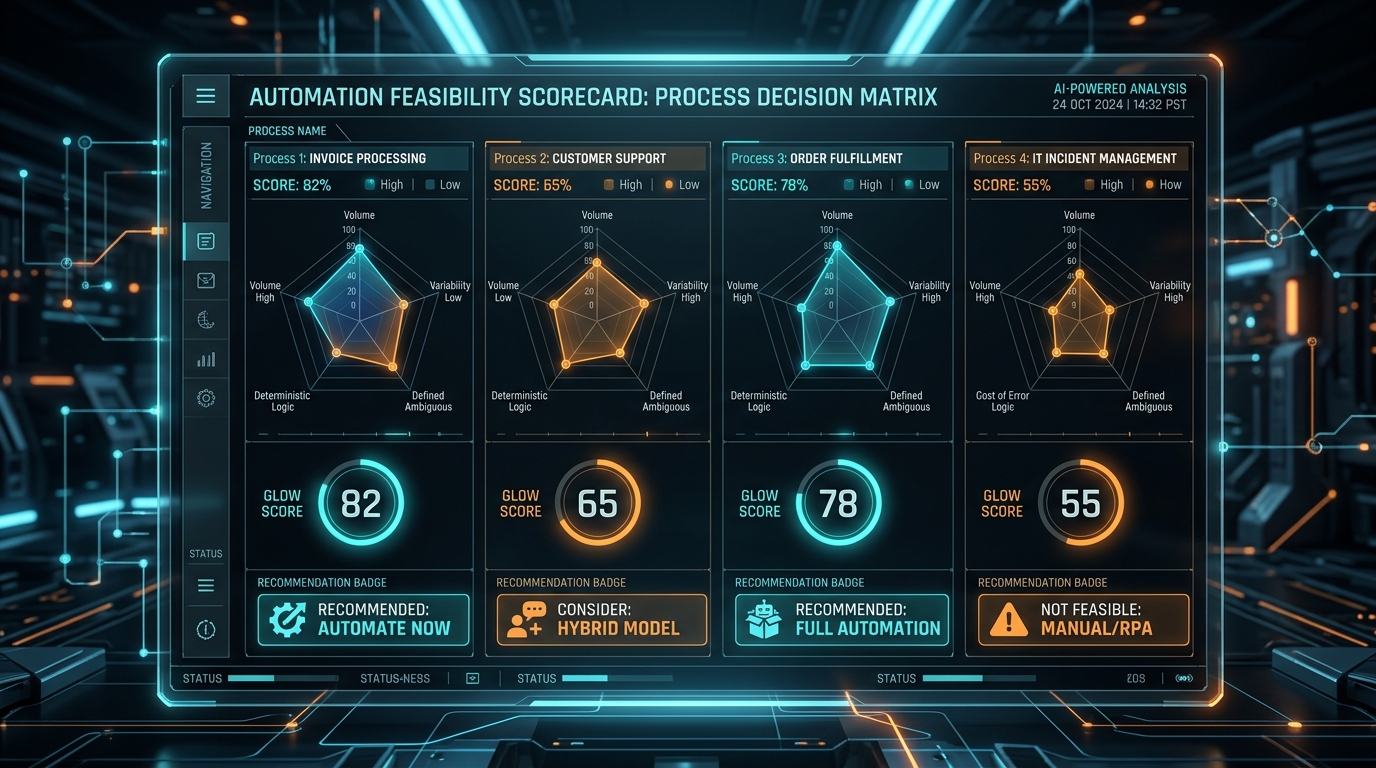
Not every workflow needs an AI agent. To prevent wasted budget, we use a scoring framework to identify high-ROI opportunities.
Evaluate your internal processes against these four criteria:
- Volume and Repetition (1-5 points): Is this task performed hundreds of times a week? High volume means small efficiency gains compound quickly.
- Data Structure Variability (1-5 points): Is the input data unstructured or semi-structured (e.g., free-text emails, varied PDF formats, audio transcripts)? AI agents excel at normalizing messy human input into structured JSON.
- Deterministic Logic Requirements (1-5 points): Does the process require rigid mathematical accuracy (low score) or semantic interpretation (high score)? LLMs are bad at math but great at extracting intent.
- Cost of Error (1-5 points): If the agent makes a mistake, is the outcome catastrophic (low score) or merely an inconvenience that can be easily fixed (high score)?
Target processes that score high in Volume, Variability, and Interpretation, but have a low Cost of Error.
3 High-ROI Touchpoints for Growing Businesses
Instead of attempting to build an all-encompassing AI platform, start with specific, high-friction operational bottlenecks:
1. Automated Customer Support Triage & Resolution
- The Bottleneck: Support engineers spend 30-40% of their time manually reading emails, categorizing tickets, looking up order histories in separate systems, and routing issues to the correct department.
- The AI Agent Solution: An agent reads incoming tickets, extracts the intent, queries internal databases via API for user context, drafts accurate responses, and categorizes the ticket. It handles the busywork, allowing human agents to focus on complex resolutions.
2. Document & Invoice Data Ingestion
- The Bottleneck: Manually typing data from PDF invoices, contracts, and vendor receipts into accounting software leads to expensive typos and delays.
- The AI Agent Solution: Employs multimodal vision models to extract line items, tax IDs, and payment terms from arbitrary document layouts. It formats this data into structured JSON and automatically drafts journal entries inside your ERP (e.g., Odoo or SAP), waiting for an accountant’s approval.
3. Secure Enterprise Knowledge Retrieval (RAG)
- The Bottleneck: Team members waste valuable hours searching across disparate knowledge silos (Notion, Google Drive, Jira, Confluence) for onboarding documentation, policies, or technical specs.
- The AI Agent Solution: Deploys a role-based semantic search agent (Enterprise RAG - Retrieval-Augmented Generation) that retrieves precise internal policies and technical answers. Crucially, it enforces granular permissions, ensuring users only receive answers based on documents they are authorized to read.
The Architecture Pattern for Safe AI Integration
Building business-critical AI is fundamentally different from building a weekend wrapper app. You must design for failure, hallucination mitigation, and auditability.
1. Tool-Calling and State Management
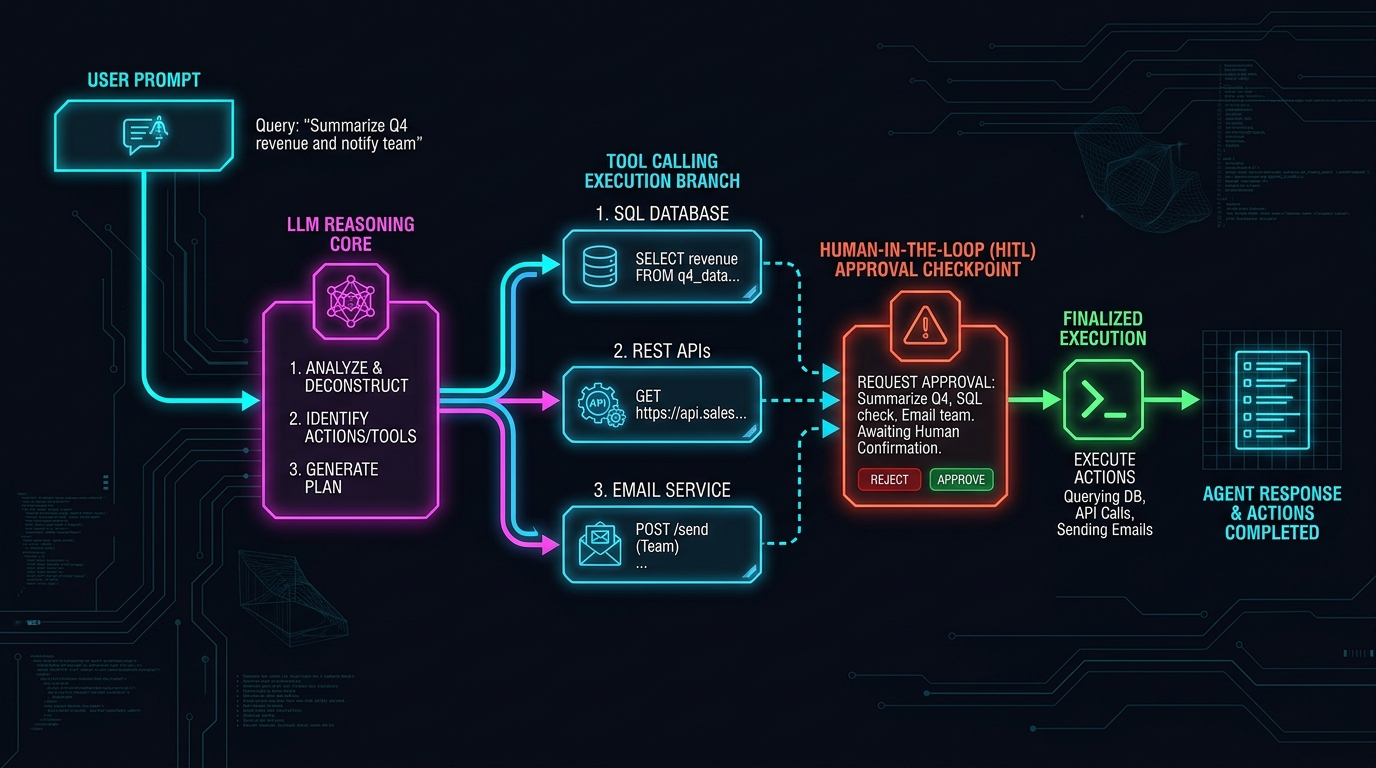
Do not rely on the LLM to write SQL queries directly against your production database. Instead, define explicit APIs (tools) that the agent can call. The agent decides which tool to use and with what arguments, but your backend system retains absolute control over the execution logic and validation.
2. Human-in-the-Loop (HITL) for Destructive Actions
For operations that mutate state (e.g., executing transactions, deleting records, sending mass emails), implement a strict Human-in-the-Loop pattern. The AI agent prepares the data payload and drafts the action, but it is placed in a “Pending Review” queue. A human employee reviews the proposed action and clicks “Approve” or “Reject.” This completely mitigates the risk of hallucination causing business damage.
3. Immutable Audit Trails
Every action taken by an AI agent must be logged. You must be able to trace exactly what the user prompted, what context was provided to the LLM, what the LLM reasoned, what tool it called, and what the final outcome was. This is essential for compliance and debugging.
Cost Estimation Principles
LLM APIs charge by the token. Unoptimized architectures can quickly result in massive AWS or OpenAI bills.
- Model Routing: Not every task requires GPT-4o or Claude 3.5 Sonnet. Route simple classification tasks to faster, cheaper models (like GPT-4o-mini or Llama 3). Reserve the frontier models only for complex reasoning and planning steps.
- Prompt Caching: Many providers now support prompt caching. By structuring your system prompts and static context effectively, you can reduce API costs by up to 50% for repeated workflows.
- Context Window Management: Do not dump your entire database into the context window. Use efficient vector search (RAG) to inject only the top 3-5 most relevant chunks of information required to complete the task.
Your Recommended Starter Project
If you want to prove the value of AI in your organization without massive risk, start here: Build an Internal Support Triage Agent.
- Connect it to an internal Slack channel or a sandbox ticketing system.
- Give it access to read documentation and query user account status (Read-Only Tools).
- Have it suggest answers and routing tags to your support team in a private thread.
- Measure the time saved per ticket over 30 days.
This project is low-risk (it doesn’t face customers), high-visibility, and immediately proves the viability of function-calling agents in your infrastructure.
Build custom AI solutions with MaxStack
Through our Build4You custom software service, MaxStack engineers purpose-built software and AI integrations that solve real operational headaches. We don’t chase trends; we focus on durable software architecture, predictable infrastructure costs, and clear business outcomes.
Ready to automate repetitive operations with a robust AI architecture? Schedule a consultation with our engineers to discuss your workflow bottlenecks.

Comments & Discussion
0Your email address will not be published.
No comments yet. Be the first to share your perspective!