
Walking into the engineering floor of any forward-operating technology firm in late 2026 reveals a fascinating paradox: Never has drafting code been so effortless, yet never has keeping a production distributed system reliable, secure, and performant been so costly and demanding.
According to global 2026 developer surveys, more than 82% of newly committed source code across Git repositories is now generated or assisted directly by Large Language Models (Cursor, Claude, Copilot, DeepSeek). An engineer can draft a concise natural-language prompt and receive 500 lines of functional code in under ten seconds.
Yet this astonishing velocity is triggering a quiet but profound reckoning across the global software delivery market:
- The traditional hourly billing model (Man-Hour / Time & Materials) is breaking down: Clients increasingly refuse to pay for tedious manual coding hours when they know generative AI can scaffold interfaces and routines in minutes.
- The Code Bloat Inflation crisis: Repository line counts are inflating by 300% to 500%, yet the volume of features that deliver genuine commercial differentiation has barely budged.
- The Verification Bottleneck: Subtle semantic errors, latent security vulnerabilities, and architectural mismatches have proliferated, transforming code review and quality verification into an engineering lead’s most stressful hurdle.
The software development market is undergoing a fundamental structural transition: The era of the “code monkey” has officially closed. The true, irreplaceable value of software engineering has decisively shifted toward System Architecture, Domain Modeling, and Automated Verification.
1. 2026 Market Realities: Code Inflation and the Collapse of Hourly Billing
For over two decades, the global IT outsourcing industry operated on a straightforward economic premise: Clients buy developer time to translate written feature requirements into executable syntax.
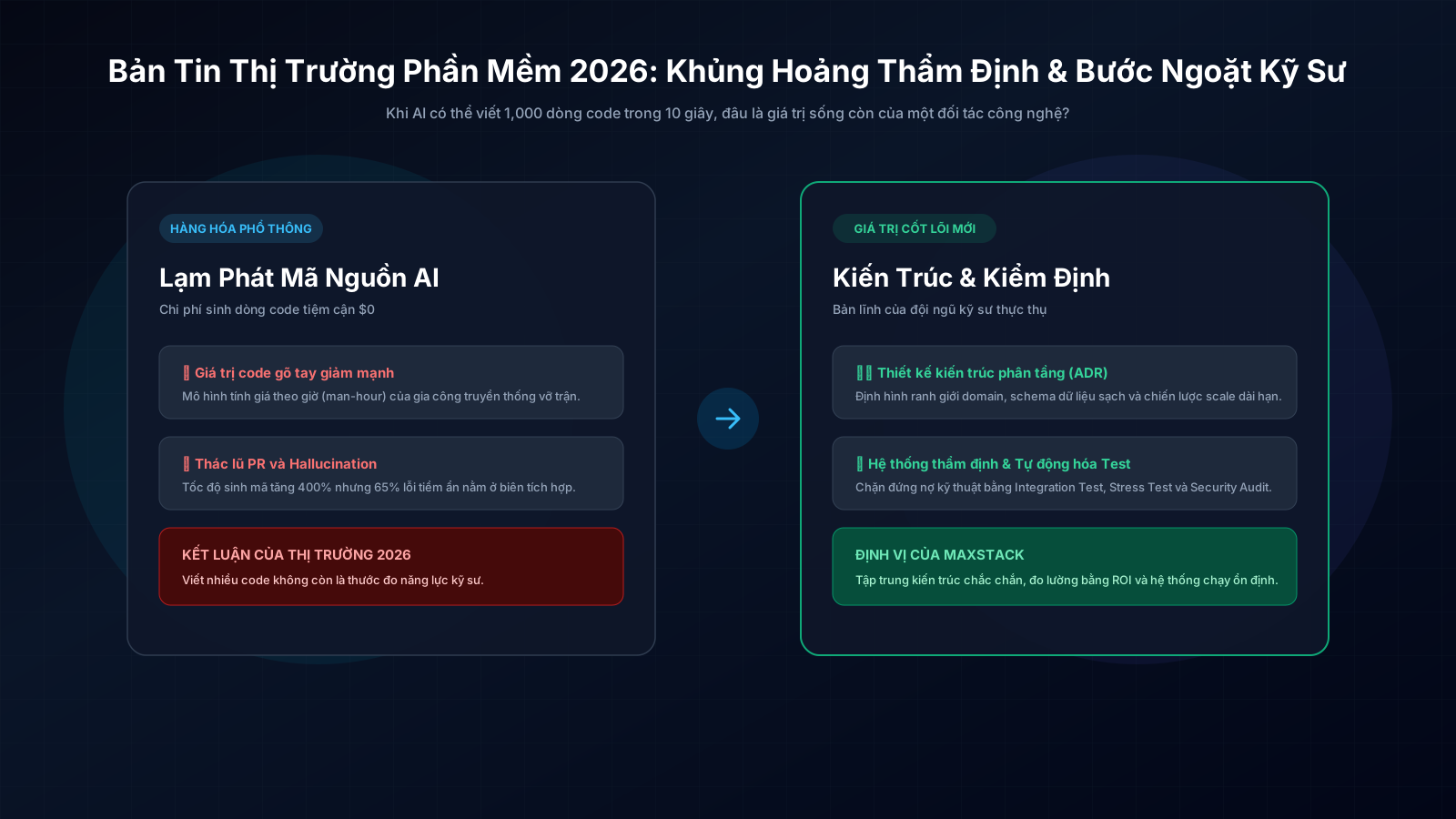 Figure 1: 2026 software engineering landscape — AI code inflation and the migration of enterprise value toward system architecture.
In 2026, this premise has disintegrated under the pressure of three market realities:
A. Marginal Cost of Code Generation Approaches Zero
Anyone from an intern to an apprentice developer can utilize an AI copilot to generate a login screen, scaffold a standard CRUD REST API, or draft database query wrappers in a few keystrokes. When syntax generation becomes an industrialized commodity, no rational buyer will pay $40 to $70 an hour for boilerplate code creation.
B. The Hazard of “Syntactically Correct, Semantically Broken” Code
Modern AI models excel at generating code that compiles cleanly and passes basic happy-path scenarios. But when subjected to production traffic with millions of relational rows, catastrophic failures emerge:
- Lack of pessimistic locking during concurrent ledger writes, causing subtle race conditions.
- Massive N+1 query cascades that exhaust database connection pools during peak traffic spikes.
- Careless omission of boundary validation, leaking sensitive authorization headers through intermediary logging sinks.
C. Hyper-Accelerated Technical Debt
When generating code is virtually frictionless, undisciplined teams habitually stack copy-pasted AI snippets without grasping underlying mechanics. Within six months, a modest greenfield project degenerates into an unmaintainable monolith. Fixing a defect in the billing module silently breaks authentication and inventory sync.
2. The Verification Bottleneck
This shift is captured in the defining engineering metric of 2026:
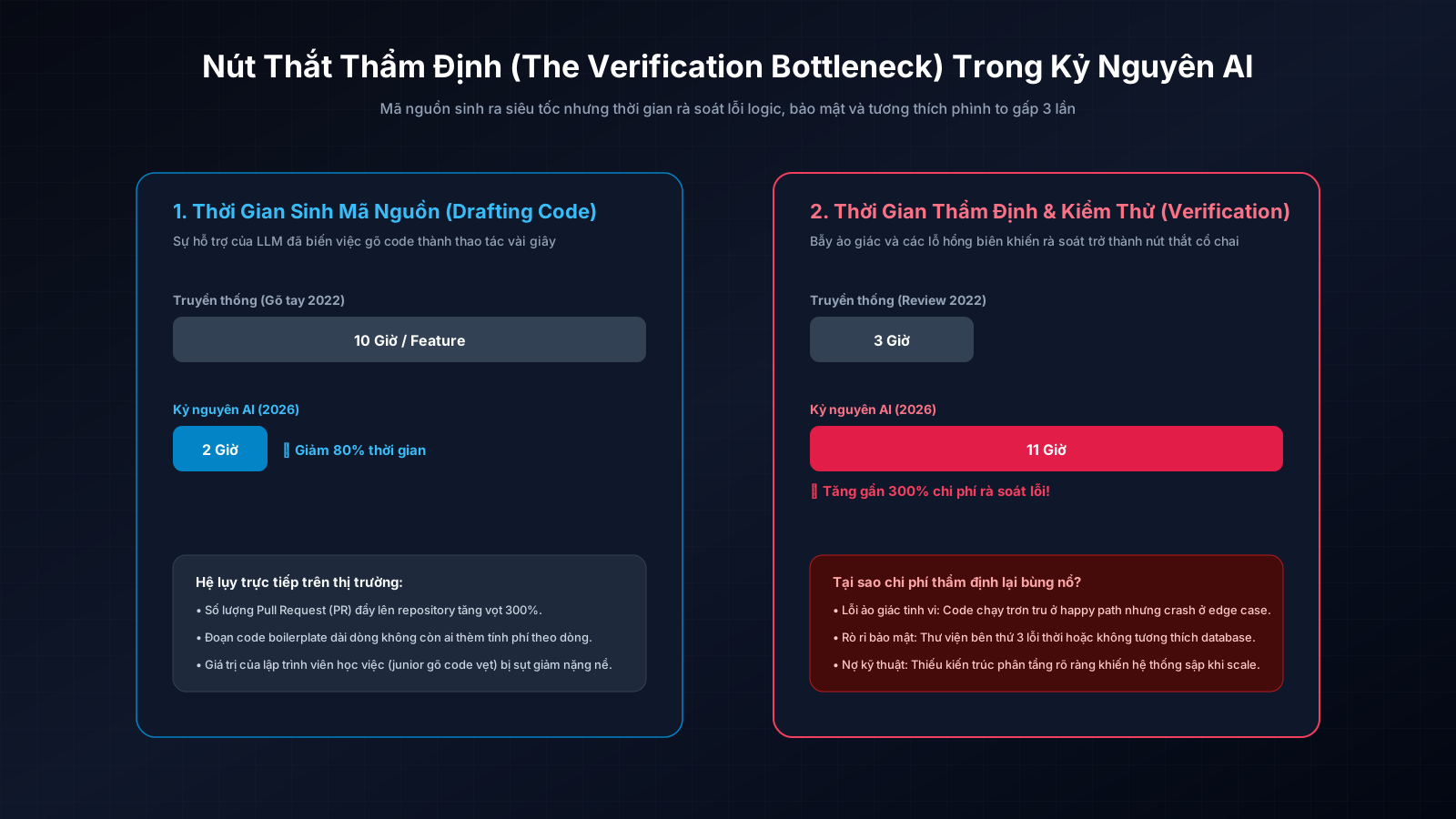 Figure 2: The Verification Bottleneck — Coding time dropped by 80% while verification and testing effort increased by 300%.
Historically, the time allocation between Writing Code vs. Review/Testing hovered around 70 : 30. In the 2026 AI-augmented era, that ratio has completely inverted to 20 : 80:
- Drafting Code: Has dropped by 80%. A proficient engineer can scaffold an entire subsystem in a single morning.
- Verification & Testing Overhead: Has increased by nearly 300%. To ensure AI-generated modules do not harbor logic traps or destabilize upstream infrastructure, senior architects must dedicate triple the effort to:
- Authoring robust automated test suites (Unit, Integration, Contract, and E2E tests).
- Reviewing relational schemas to prevent data duplication and normalization anomalies.
- Conducting rigorous load profiling and benchmarking under simulated real-world conditions.
“A developer using generative AI without architectural guardrails is like a driver in a Formula 1 car with no brakes. You can accelerate rapidly for the first 100 meters, but the impending crash at the first bend will destroy the vehicle.”
3. The 2026 Software Engineering Value Pyramid
Faced with this market transformation, how should organizations evaluate the real caliber of a software partner or senior engineer?
The 2026 Engineering Value Pyramid delineates the four tiers of modern technical competency:
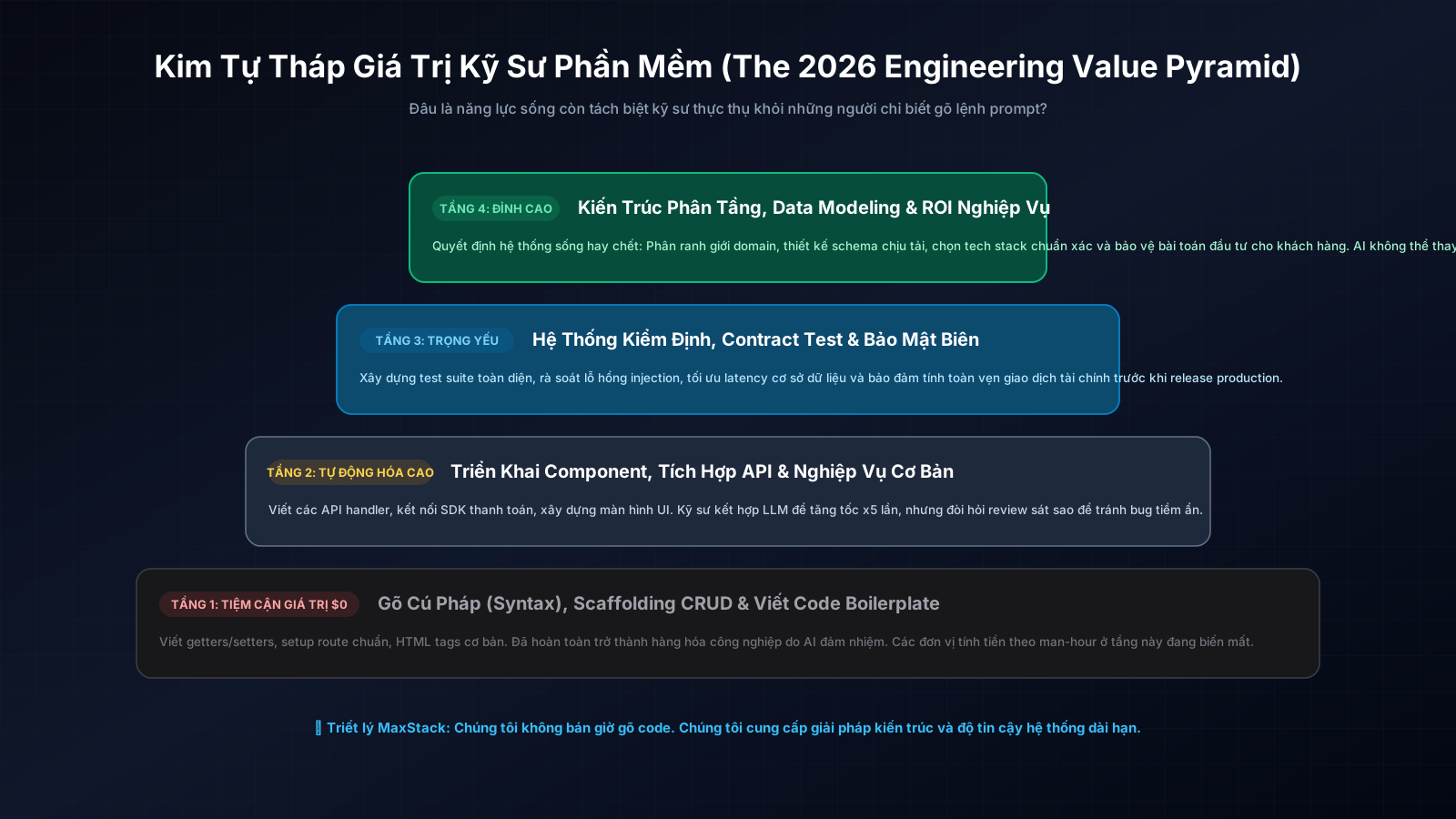 Figure 3: The 2026 Engineering Value Pyramid — Transitioning from boilerplate syntax to layered architecture and measurable business ROI.
Tier 1: Syntax Generation & Boilerplate Scaffolding (Commodity / $0 Value)
The bottom tier encompasses repetitive coding tasks: writing CRUD handlers, configuring routers, basic CSS alignment. AI models execute this flawlessly. IT agencies competing strictly on developer headcounts in this tier face systemic obsolescence.
Tier 2: Component Implementation & API Glue Logic (Highly Automated)
Engineers orchestrate third-party libraries, connect payment SDKs, and build UI components from Figma mockups. Here, AI accelerates output by 3x to 5x, yet demands skilled oversight to prevent code redundancy.
Tier 3: Automated Verification, Security & Boundary Defense (Mission-Critical)
This represents the enterprise’s defensive perimeter. Engineers design comprehensive test suites, configure automated static security analysis pipelines, execute stress testing, and establish distributed observability tracing. Any code failing this tier is halted before touching production.
Tier 4: Layered Architecture, Data Modeling & Business ROI Alignment (Pinnacle Value)
The highest tier of technical craftsmanship, which no generative AI model can replace:
- Defining Bounded Contexts: Segmenting complex operational realities into decoupled, manageable domains, enabling systems to scale from 1,000 to 100,000 concurrent users without rewrites.
- Data Modeling: Designing resilient database schemas that guarantee transactional integrity and minimize cloud infrastructure costs.
- Economic Alignment: Selecting the simplest viable solution to solve a business problem, refusing unnecessary complexity that wastes client capital.
4. How Enterprises Must Update Their Technology Procurement Criteria
For founders, CTOs, and business executives procuring software development services in 2026–2027, three procurement rules are vital:
- Shift from “Hours Billed” to “Deliverable Outcomes”: Contract software delivery based on verified milestone deliverables and system reliability metrics (SLAs, uptime, test coverage). An experienced architect wielding AI can solve a complex problem in 4 hours far more sustainably than a team of 5 junior developers working manually for 2 weeks.
- Scrutinize Verification Protocols Before Coding Speed: Instead of asking “How fast can you show me screens?”, ask: “What is your automated test strategy? What is your minimum test coverage threshold? Who audits the code for security and schema anomalies?”
- Require Architectural Decision Records (ADRs): Demand documented architectural rationales clarifying why specific technologies were selected, how data boundaries are isolated, and how the system will scale cleanly over a 3-year horizon.
5. The MaxStack Engineering Philosophy
At MaxStack, we fully embrace AI as a high-leverage accelerator for rapid implementation, but we never mistake generative tools for rigorous engineering judgment.
Every system delivered by MaxStack is anchored by three uncompromising tenets:
- Clean Layered Architecture (Stack in Layers): Core business logic remains strictly isolated and independent of transient frameworks or closed vendor clouds.
- Comprehensive Automated Verification: Automated test suites defend every financial transaction and critical business data pipeline.
- Relentless Focus on Measurable ROI: We do not sell bloated feature lists. We architect lean, durable, and cost-efficient software systems that deliver sustainable enterprise value.
This report is derived from ongoing research into global developer market dynamics and MaxStack’s enterprise consulting engagements.

Comments & Discussion
0Your email address will not be published.
No comments yet. Be the first to share your perspective!