
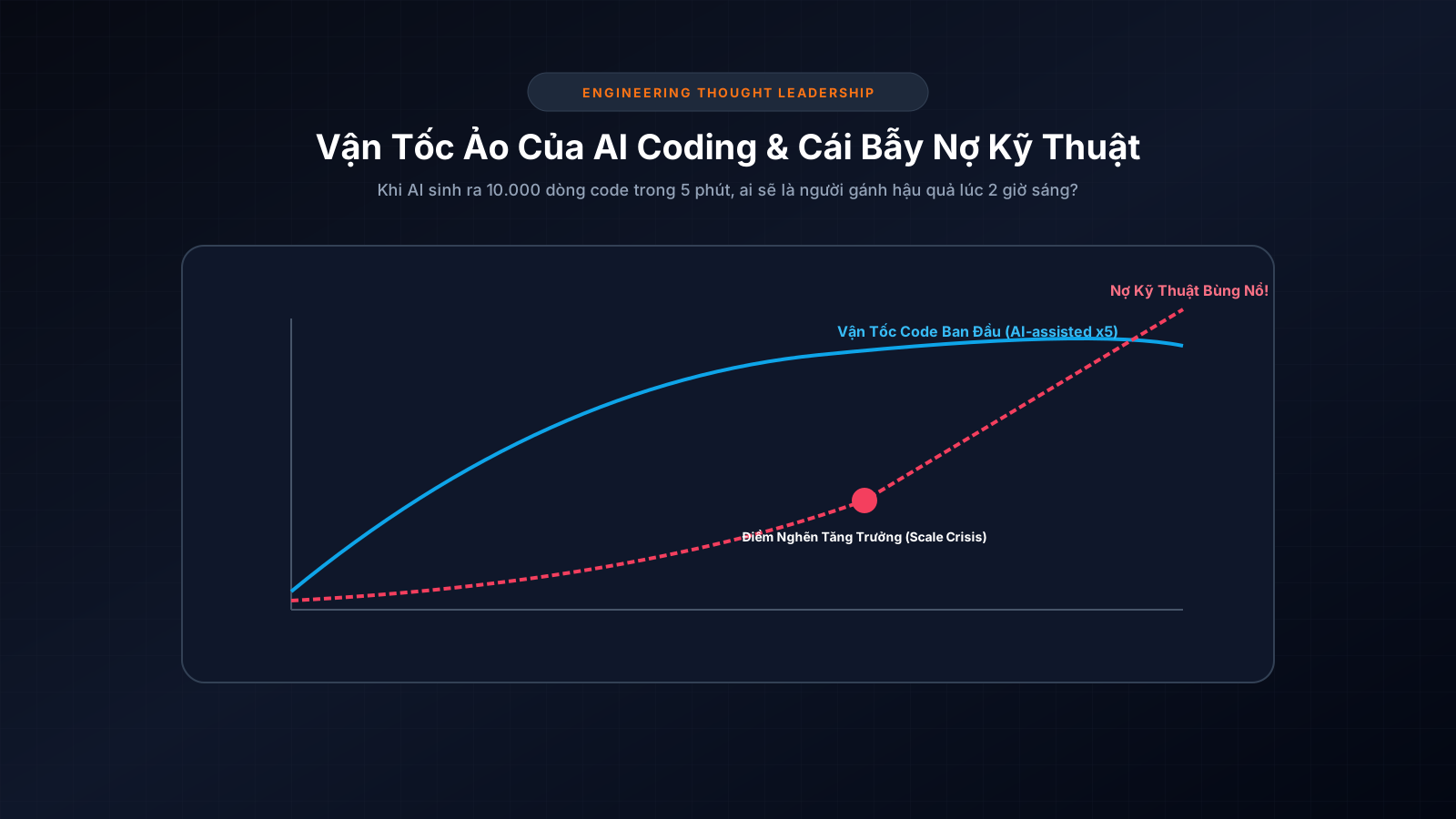
There is a running joke circulating through engineering teams in 2026:
“In 2022, it took 2 weeks to build a feature and 2 days to debug. In 2026, thanks to AI coding agents, it takes 2 minutes to generate 5,000 lines of code, and 3 weeks to figure out why production crashes at 2 AM.”
If you check tech channels today, you will see endless praise for autonomous coding agents (like GitHub Copilot Workspace, Devin) and LLM-assisted workflows. They scaffold full-stack applications in seconds, generate APIs based on loose prompts, and submit pull requests automatically. Developer output is reported to have jumped by 300% to 500%.
Sounds like an executive’s dream come true? Only partly. The other half is an escalating crisis silently brewing in repositories worldwide: AI-induced Technical Debt. When the speed of code generation outpaces the speed of architectural thought, enterprises are borrowing from their future at exorbitant interest rates.
1. The Illusion of Velocity (Phantom Velocity)
Software engineering was never about typing speed. If typing were the bottleneck, programmers would have been replaced by court stenographers decades ago. The enduring value of an engineering team lies in architectural discipline, bounded contexts, and the maintainability of a system across a 5-year lifecycle.
When junior engineers wield frontier AI agents, they can produce working prototypes at breakneck speed. Management looks at the sprint board and celebrates. But what is lurking beneath those 10,000 auto-generated lines?
At the code level, AI-induced technical debt manifests in highly specific, destructive patterns:
- Tangled spaghetti dependencies: Code generated without Domain-Driven Design (DDD) principles. AI tends to solve problems locally rather than systematically. As a result, modules become tightly coupled. A minor tweak to a shopping cart pricing logic inadvertently breaks the user authentication flow.
- Dubious third-party dependencies and supply chain risks: AI models frequently hallucinate or aggressively pull in obscure npm/pypi packages just to quickly solve a regex or sorting problem. This not only bloats the application but introduces severe zero-day vulnerabilities and serious license conflict risks.
- Loss of edge-case comprehension: AI usually generates the “happy path.” Nobody on the team truly understands the data flow when a database timeout occurs or when network latency spikes, because nobody designed the core logic by hand.
The verdict: You save one week of initial development, only to spend six months firefighting regressions, scaling server costs, and dealing with corrupted data once user traffic ramps up.
2. The Paradigm Shift: From Code Typists to System Architects & Reviewers
The software engineering profession is fundamentally bifurcating. The value of a software engineer is no longer measured by the volume of code they push per day.
[Pre-2024 Baseline]              [Modern Engineering Era]
Software Engineer                Engineer + Autonomous AI Agent
      │                                     │
      ▼                                     ▼
Manual Coding ──────────────────► Hyper-speed Generation (5x Velocity)
      │                                     │
      ▼                                     ▼
Linear Technical Debt             Exponential Debt Accumulation!
                                            │
                                            ▼
                                  IMPERATIVE NEED:
                         Elite Architecture & Code Verification
Today’s most effective engineers act like rigorous editors or project managers overseeing AI agents. They spend 80% of their time reading, reviewing architecture, and thinking about domain boundaries, and only 20% prompting code generation.
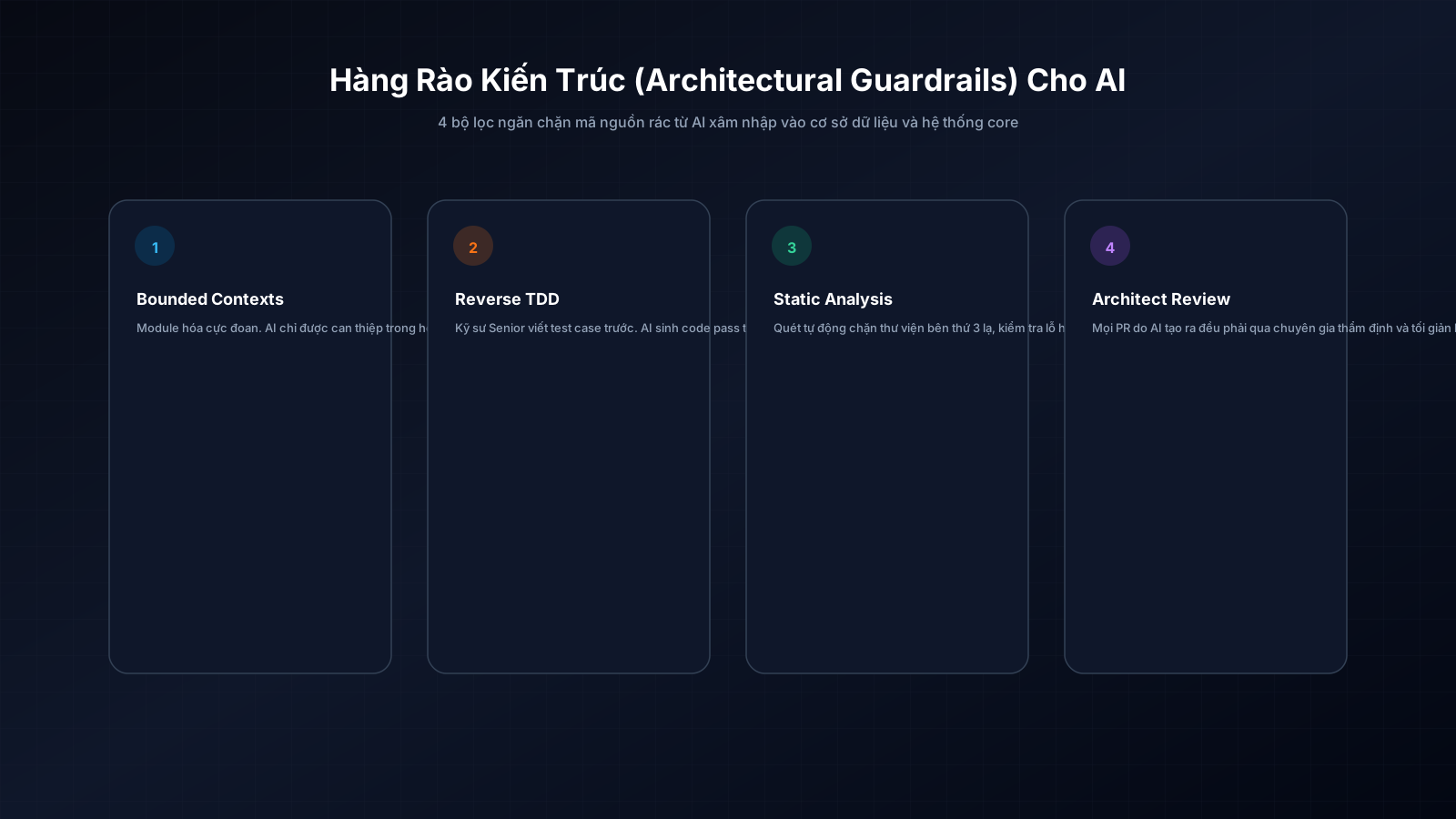
3. Establishing Architectural Guardrails Before Unleashing AI
Forward-thinking enterprises do not use AI to dump more unverified code into their repositories. Before handing out GitHub Copilot licenses to the entire team, CTOs must erect solid architectural guardrails:
- Mandate ADRs (Architecture Decision Records): Require every major structural change to be documented (Why use this library? Why split this microservice?). AI can generate the implementation, but the engineer must explain the design rationale.
- Strict Code Review Checklists: Never merge a Pull Request just because “it runs fine locally.” The checklist must ask: Can this code be shorter? Are edge cases covered? Are there circular dependencies? Does it violate our domain boundaries?
- Extreme Modularity (Bounded Contexts): Decompose architectures into isolated services or modular monoliths with strict boundaries. If an agent outputs flawed code, it remains sandboxed within its domain, preventing it from jeopardizing primary core databases.
- Valuing Less Code Over More: The best solution is rarely the 500-line complex block hallucinated by an agent utilizing fancy design patterns. The best solution is a 50-line clean abstraction that solves the problem permanently and transparently.
4. The Critical Role of Testing in an AI-Augmented Team
When code generation speed increases 5x, the speed of bug creation also increases 5x without proper brakes. Automated Testing transitions from a “nice-to-have” luxury to a matter of life and death.
- Reverse Test-Driven Development (TDD): Instead of prompting the AI to build the feature immediately, prompt the AI to write a comprehensive suite of Unit and Integration Tests based on business requirements first. Only after humans have rigorously reviewed the test cases should the AI be allowed to generate the executable code to pass those tests.
- Automated Verification Pipelines: Enforce strict CI/CD gates. Any AI-generated code must automatically pass through static analyzers (SonarQube), security scanners (Snyk, Dependabot), and end-to-end test suites (Cypress, Playwright) before a human even looks at the PR.
5. Making the Business Case: “Slow Down to Speed Up”
How does a CTO explain to a non-technical CEO that forcing the engineering team to use AI to squeeze a 3-month project into 3 weeks is a terrible idea?
Use the language of business: The Compound Interest of Technical Debt. “Dear CEO, AI is like a high-limit credit card. It allows us to launch features incredibly fast today, but for every feature deployed without architectural scrutiny, we are taking out a loan against our future capacity. Eventually (usually right when we hit high revenue and need to scale), our entire team will grind to a halt. They won’t be able to ship anything new because 100% of their time will be consumed by patching the interconnected legacy mess. To maintain our growth velocity over the next 3 years, we must invest time in building the foundation (Automated Tests, Review Processes) today.”
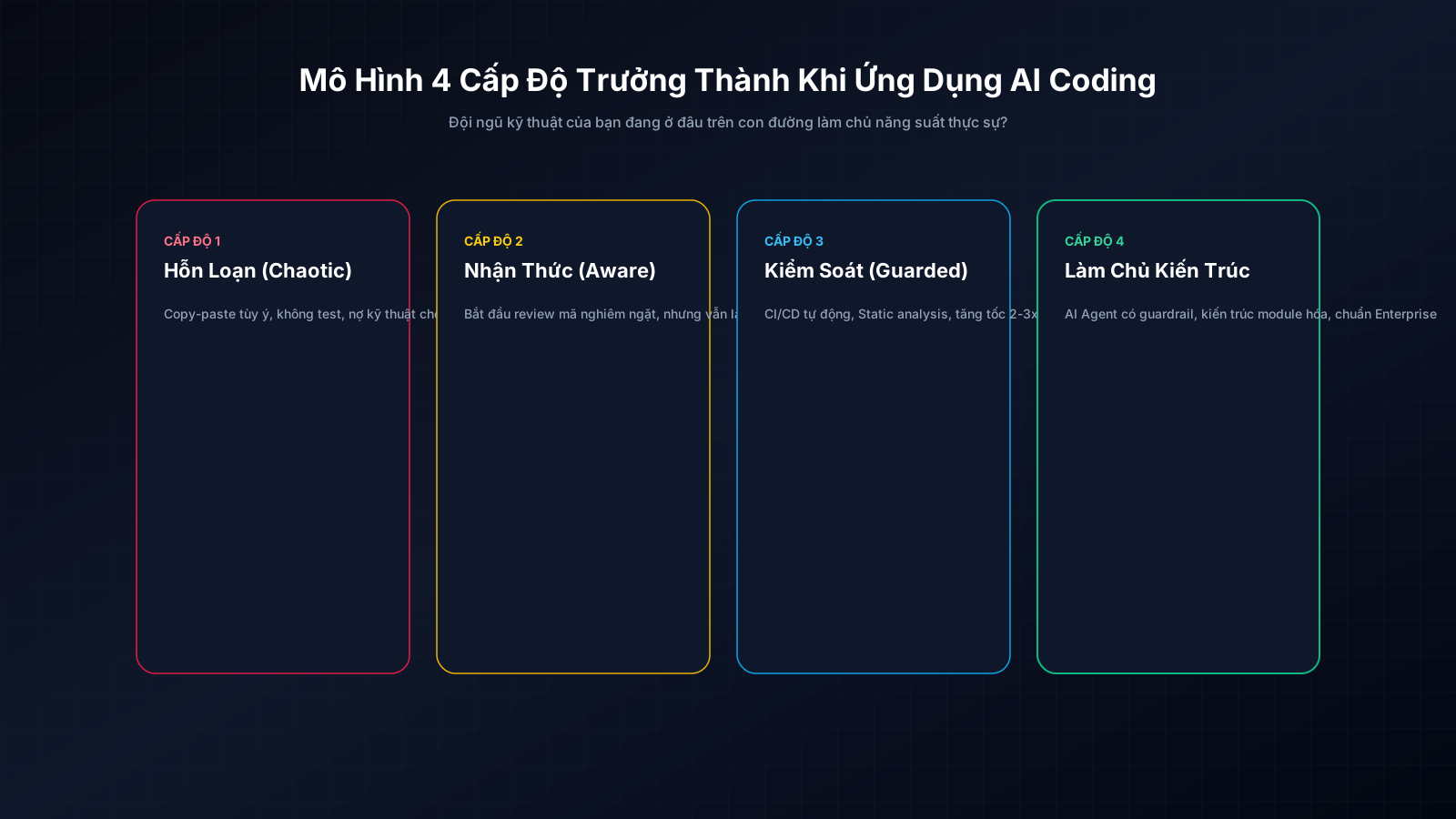
6. AI Adoption Maturity Model for Software Teams
Assess where your organization stands:
- Level 1 (Chaotic): Developers blindly copy-paste ChatGPT/Copilot code into production. No rigorous review process. High initial velocity, but plagued by hidden bugs and security risks.
- Level 2 (Awareness): The team recognizes the danger of AI-generated bloatware. Manual code reviews exist but are frequently skipped when deadlines approach.
- Level 3 (Guarded): Strict CI/CD pipelines are established. Test coverage is >70%. All AI-generated code must pass through automated quality and security gates.
- Level 4 (Architectural Mastery): The team uses AI not just to generate new logic, but to reverse-engineer existing technical debt, suggest refactoring strategies, and automatically generate test cases for legacy code. Human engineers focus entirely on Domain-Driven Design and Product Strategy.
Sustainable Engineering with MaxStack
At MaxStack, we believe that technology only generates true enterprise value when it runs stably, securely, and efficiently over the years. We do not chase the trend of blindly inflating codebases to report phantom progress; we apply AI with strict discipline, focusing intensely on Clean Architecture and Enterprise-Grade Quality Control.
Whether your organization needs:
- Architecture Audit & Strategic Refactoring: Cleaning up legacy debt to prepare for an aggressive scale-up phase.
- Or a clean-slate greenfield project built under our Build4You model, equipped with enterprise-grade standards from day one.
Do not let unmanaged technical debt silently erode your future operating margins and burn out your core engineering talent. Schedule a strategic 30-minute architectural consultation with our senior team at Contact MaxStack — we deliver practical solutions, zero fluff.

Comments & Discussion
0Your email address will not be published.
No comments yet. Be the first to share your perspective!