
Examining the technology procurement patterns and financial disclosures of mid-market and enterprise organizations throughout the first half of 2026 reveals an unmistakable market signal: The era of the “All-in-One Mega Suite” has decisively ended.
Only a few years ago, the default playbook for Chief Technology Officers and Operations Directors was to contract with mega-vendors: an all-encompassing software suite claiming to unify CRM, ERP, HRM, project tracking, inventory management, and customer support. The sales pitch was universally compelling: “A single vendor, every department aligned on one system, production-ready in thirty days.”
Yet after three to five years of operational reality, the uncomfortable truth has surfaced:
- Companies actively use less than 15% of the features included in these massive platforms, yet are forced to pay for 100% of the licensing fees under aggressive per-seat pricing models.
- Core proprietary business workflows — the exact operational edges that differentiate a company from its rivals — are routinely warped and compromised just to fit into rigid off-the-shelf forms.
- Whenever an enterprise attempts to scale or integrate with external partner networks, vendors demand an upgrade to premium Enterprise tiers, triggering 40% to 80% price hikes at renewal.
This dynamic is fueling a structural re-architecture across the 2026 enterprise technology landscape: The Great Unbundling of generic software monoliths and the rapid ascent of Vertical Platforms anchored by proprietary Private Cores.
1. 2026 Market Intelligence: Why Are Generic Software Supermarkets Stalling?
Recent Q2 2026 enterprise software market surveys across Southeast Asia and global B2B sectors show that budget allocations for renewing generic horizontal SaaS suites dropped by an average of 18%, while spending on tailor-made vertical software and bespoke core development surged by 32%.
 Figure 1: Architectural concept depicting the unbundling of bloated monolithic software into specialized task-specific engines and a proprietary data core.
Three structural economic and technical drivers explain this decisive pivot:
A. The Tax of Bloatware
A generic monolithic enterprise platform contains millions of lines of legacy code engineered to appease everyone from retail conglomerates in North America to hospital chains in Europe. In attempting to serve every conceivable edge case, the software becomes paralyzed with labyrinthine nested menus, brittle configuration trees, and sluggish page loads.
A frontline operations coordinator who merely needs to record a shipment and verify warehouse stock is forced to endure a heavy web application loading hundreds of vendor JavaScript bundles just to render a simple table. Accumulated wait times, operational input errors, and daily user friction represent a substantial hidden operating cost buried in company payroll.
B. The Imperative of Data Sovereignty
In the practical AI landscape of 2026, proprietary transactional data is the cornerstone asset required to fine-tune and ground autonomous AI agents.
When your complete pricing history, customer communication logs, and routing heuristics reside inside the proprietary black-box database of a closed SaaS provider, you have effectively surrendered ownership of your core intellectual property. Forward-thinking engineering leaders have recognized the fundamental rule: Data residing in a third-party closed SaaS is never truly yours unless you maintain unrestricted, direct query access at the database level.
C. Market Velocity Outpacing Vendor Roadmap Cycles
When your business model adapts monthly in response to shifting regional supply chains and customer demands, you cannot afford to submit a “feature request ticket” to an offshore vendor and wait six to twelve months for a vague roadmap release. Modern enterprises demand software architectures that internal or trusted engineering partners can inspect, customize, and deploy within 24 to 48 hours.
2. Architectural Comparison: Bloated Monolith vs. Layered Private Core
To clarify the structural differences and underlying financial models, consider this side-by-side engineering comparison:
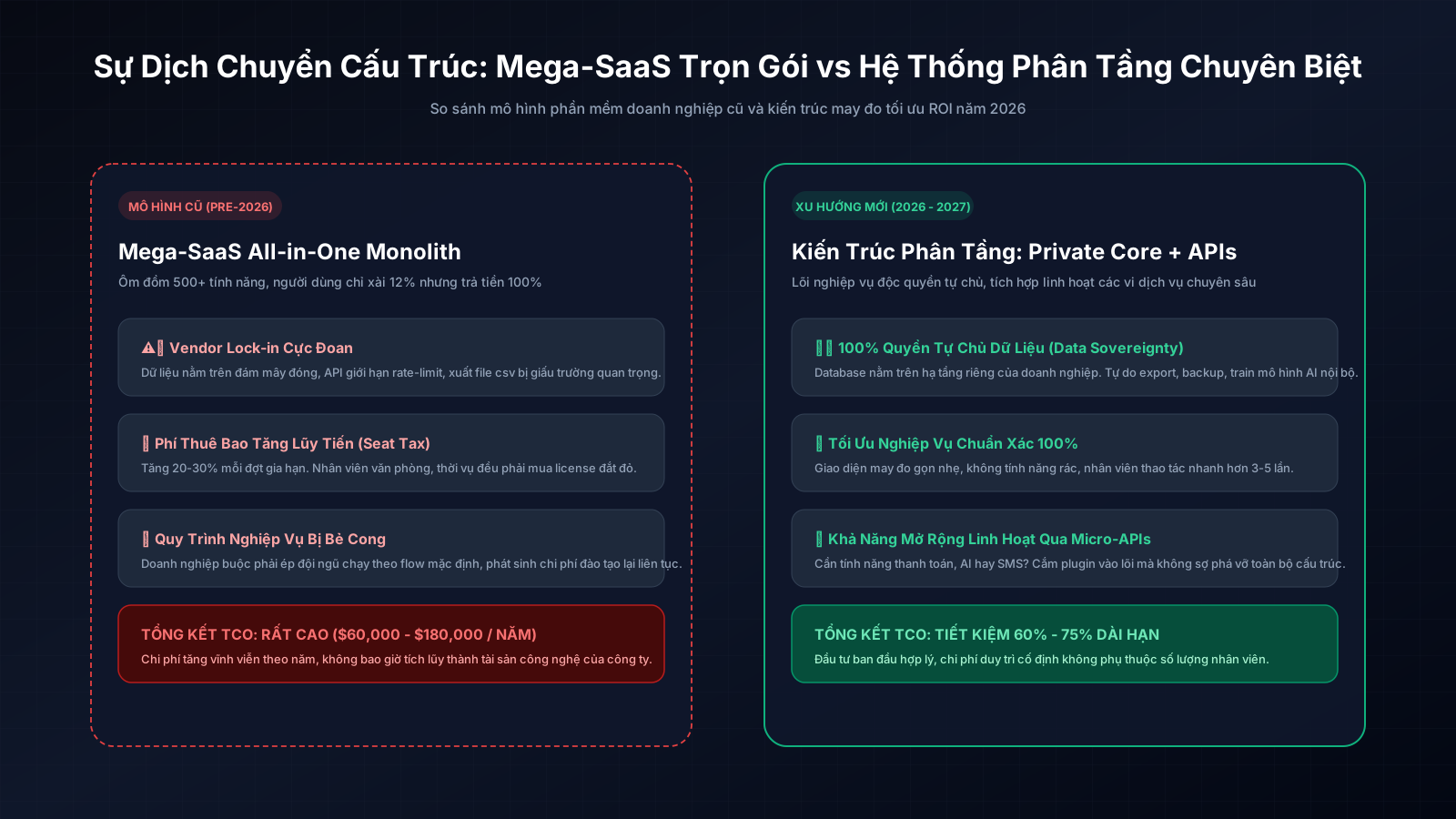 Figure 2: Architectural comparison between legacy all-in-one mega suites and the decoupled private core model.
| Evaluation Factor | Legacy Mega-SaaS Suite | Modern Layered Private Core |
|---|---|---|
| Codebase Ownership | 100% rented; zero ownership | Full corporate intellectual property (IP) ownership |
| Pricing Economics | Compounding per-seat fees; frequent annual hikes | Predictable upfront capital investment; flat hosting costs |
| Workflow Alignment | 60% – 70% (Forces staff to conform to generic templates) | 100% tailor-made to actual operational logic |
| UI Performance & Latency | 1.8s – 4.5s (Heavy bloated scripts and DOM trees) | < 300ms (Lean, task-focused interfaces) |
| Internal AI Integration | Locked into expensive, proprietary vendor add-ons | Direct plug-and-play with OpenAI, Anthropic, DeepSeek, or local LLMs |
| Vendor Lock-in Risk | Severe; massive data migration penalties | Zero; fully portable across standard cloud/on-prem infrastructure |
3. Capital Reallocation: Where Are Enterprise Technology Budgets Moving?
The “Unbundling” movement does not imply that enterprises should write their own spreadsheet programs or email servers from scratch. Rather, leadership teams are adopting a pragmatic, three-tier capital allocation model:
- The Commodity Layer: Continue leveraging hyper-standardized, low-cost utility tools such as Google Workspace, Microsoft 365, or Slack.
- The Proprietary Core: Channel the majority of capital expenditures into building a custom, owned software core for workflows that directly generate revenue or protect competitive advantages (e.g., custom quoting calculators, logistics routing algorithms, manufacturing execution systems, and B2B client portals).
- Specialized Micro-APIs: Flexibly integrate best-in-breed niche endpoints (e.g., payment gateways like PayOS/Stripe, e-invoicing providers, transactional SMS/WhatsApp gateways) via clean REST/gRPC interfaces without granting them governance over the core data layer.
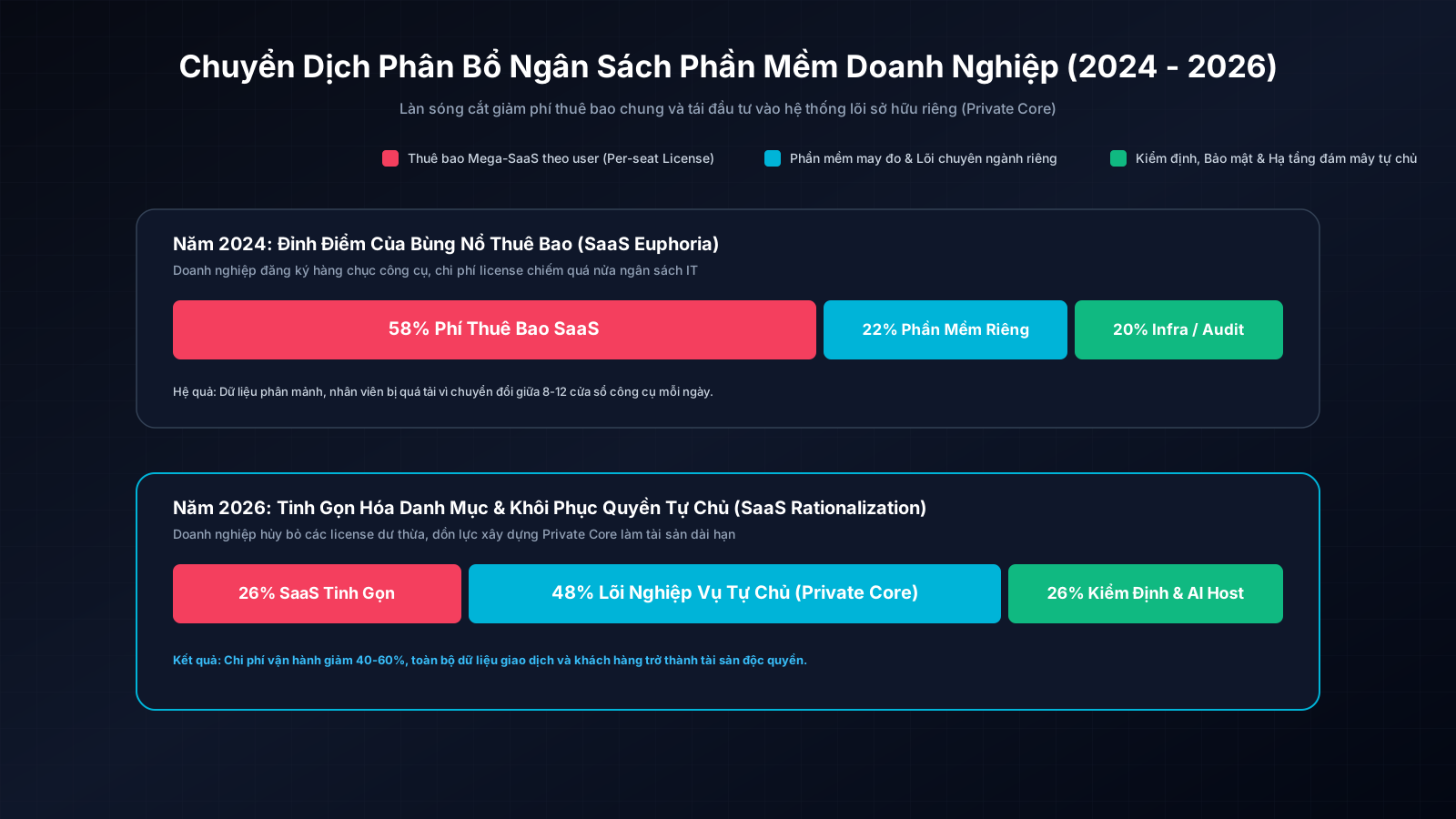 Figure 3: Corporate software budget allocation shift from 2024 to 2026, showing the reallocation of funds into owned core platforms.
Empirical metrics from enterprise software modernization initiatives delivered by MaxStack across 2025 and 2026 highlight:
- Companies transitioning from 150-seat Enterprise SaaS bundles to a bespoke Private Core realized an average 62% reduction in Total Cost of Ownership (TCO) over a 24-month horizon.
- Operational throughput increased by 35% to 50% across order fulfillment teams due to the elimination of multi-step navigation and application latency.
4. Practical Framework: When Should You Unbundle and Build Your Core?
Not every company needs to immediately replace their existing software footprint. The decision to unbundle and build should be governed by cold operational arithmetic:
Diagnostic Triggers for Building a Private Core:
- Monthly SaaS licensing exceeds $2,500/month, while actual daily team usage is concentrated within 2 to 3 operational screens.
- Severe Data Fragmentation: Operational staff spend hours copying and pasting records between disparate tools because the vendor’s basic tier disables webhooks or charges exorbitant enterprise integration fees.
- Client or Partner Friction: External order portals or client-facing dashboards are slow, unbranded, and fail to offer intuitive self-service capabilities.
- Strict Compliance & Security Mandates: Businesses in manufacturing, healthcare, logistics, or fintech require localized data storage and strict access controls to meet statutory requirements.
5. Strategic Recommendations for 2026 – 2027
At MaxStack, our guiding engineering philosophy remains straightforward: The best software is not the one with the longest feature list, but the one that aligns most precisely with your economic objectives.
If your organization is evaluating a software architecture review over the coming quarters, execute these three foundational steps:
- Conduct a Rigorous SaaS Audit: Catalog every recurring software subscription, audit active login frequency against paid seat counts, and map actual feature utilization.
- Delineate Core vs. Non-Core Workflows: Pinpoint the 20% of operational workflows that create 80% of your company’s unique market advantage. That is your primary candidate for a bespoke Private Core.
- Adopt a Stack-in-Layers Delivery Model: Never attempt a “big-bang” total rewrite. Establish the central data repository and API layer first, and modernize individual modules sequentially to ensure core business operations remain completely uninterrupted.
This report reflects real-world market intelligence and architectural advisory experience from the MaxStack engineering team.

Comments & Discussion
0Your email address will not be published.
No comments yet. Be the first to share your perspective!