

After years of building websites for growing businesses, MaxStack is making a definitive strategic move: we are sunsetting our WordPress website development service (WPPro) to focus 100% of our web engineering resources on Astro SSG (Static Site Generation).
This is not just an internal tech decision; it is a commitment to delivering durable, high-converting digital assets that keep our clients ahead in 2026 and beyond.
Imagine this scenario: your marketing team has just launched a major Q3 campaign. You are spending thousands of dollars a day on Google and LinkedIn Ads. Prospects are clicking the links, the ads are performing beautifully on the platform, but your Google Analytics shows a terrifying reality—a 65% bounce rate before the page even fully loads. When your engineering team investigates, the culprit is the same as it has been for a decade: a bloated, slow, and fragile WordPress architecture buckling under the weight of concurrent traffic.
We have seen this exact story play out with dozens of mid-market and enterprise clients. They come to us exhausted by constant plugin updates, mysterious security warnings, and performance scores that seem permanently stuck in the red.
For years, we optimized WordPress installations. We added enterprise-grade caching, upgraded to expensive VPS hosting, and meticulously stripped away unnecessary features. But eventually, you reach the hard limits of the platform’s foundational architecture.
In 2026, the digital landscape is entirely different from the era when WordPress became the default standard. The stakes for performance, security, and conversion rates have never been higher. Let’s take a deeper look at what the WordPress ecosystem looks like today, why we made this strategic shift, and what it means for your business.
The WordPress Ecosystem in 2026: A House of Cards
WordPress powered the web of yesterday. It democratized publishing and brought millions of businesses online. However, its structural legacy has become a significant obstacle to growth for modern businesses.
1. The Plugin Sprawl and Performance Degradation
In a vanilla installation, WordPress is reasonably fast. But no business runs vanilla WordPress. To achieve modern functionality—SEO meta controls, drag-and-drop page building, multilingual support, advanced forms, analytics, and CRM integrations—you have to install dozens of plugins.
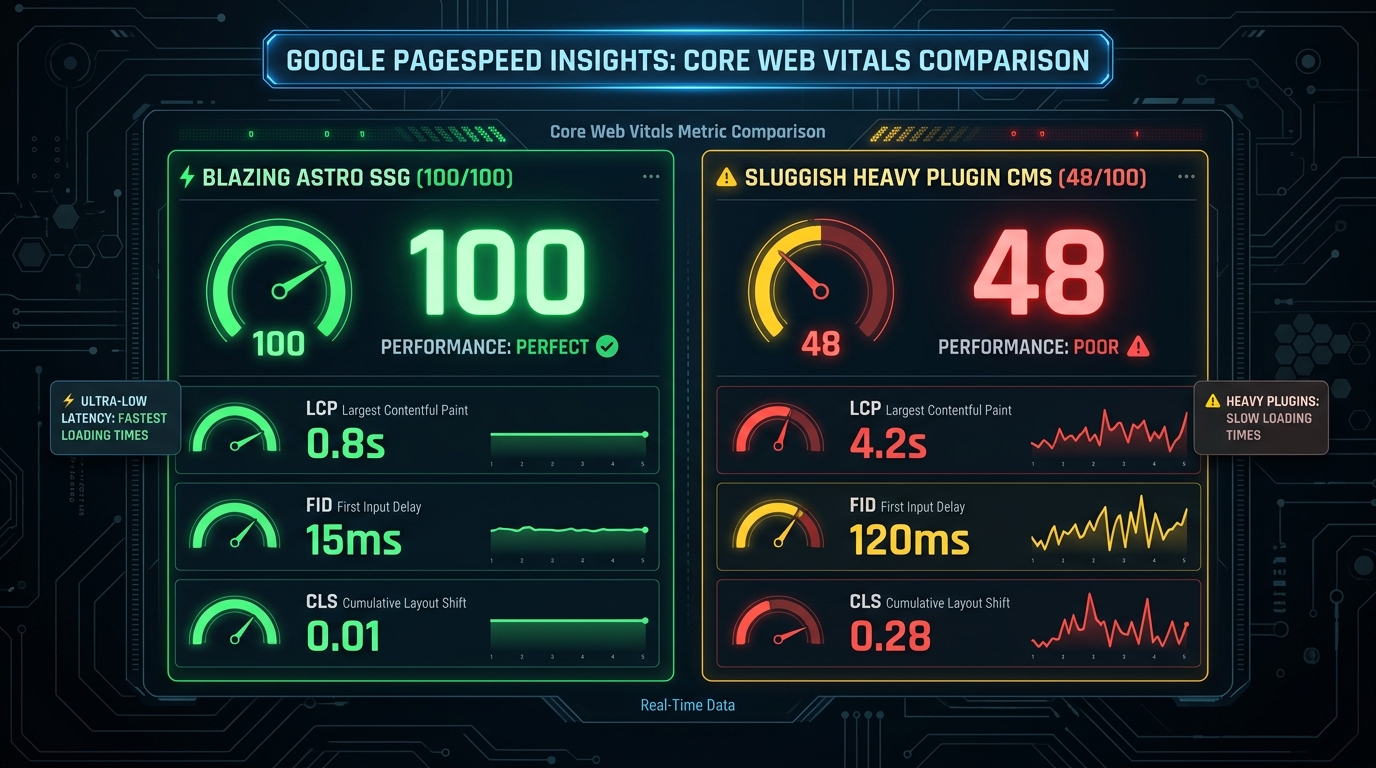
Each plugin operates as an independent piece of software injected into your site. Many of them load their own JavaScript libraries, CSS stylesheets, and database queries on every single page, whether they are needed or not. This creates a phenomenon known as “plugin bloat.” The result is a website that takes 4-6 seconds to load on mobile devices, dragging Google PageSpeed scores down into the 40–60 range.
2. Gutenberg Complexity and WooCommerce Overhead
The introduction of the Gutenberg block editor was meant to modernize WordPress, but it has added layers of complexity for content editors and developers alike. Furthermore, if you bolt on WooCommerce for e-commerce or complex catalog management, you introduce massive database overhead. Every product view, every cart addition triggers multiple queries to a monolithic MySQL database, crippling performance when traffic spikes.
3. Continuous Maintenance and Security Vulnerabilities
Because it powers a massive percentage of the web, WordPress is the primary target for automated malware scanners. The architecture relies on an active PHP runtime and a public database. If just one third-party plugin out of your 30 is abandoned by its developer and develops a vulnerability, hackers can execute arbitrary code, compromise customer data, or bring down your entire site. The maintenance burden is constant: update core, update plugins, fix the inevitable conflicts, repeat.
4. Hidden Infrastructure Costs
Dynamic PHP rendering and complex database queries require significant computing power. To survive traffic spikes from paid ad campaigns, businesses are forced to invest in expensive, high-tier VPS hosting, Redis object caching, and complex load balancing. You end up paying for enterprise infrastructure just to keep a marketing site afloat.
Speed is a Business Metric, Not an IT Problem
Why does this matter? Because in 2026, speed is no longer just a technical nice-to-have; it is a direct driver of revenue.
- Conversion Rates: Studies consistently show that every 100-millisecond delay in page load time hurts conversion rates by up to 7%.
- Core Web Vitals: Google’s search algorithms heavily penalize slow sites. A low PageSpeed score means your competitors will outrank you organically.
- Ad Spend Efficiency: Google Ads factors landing page experience into your Quality Score. A slow site increases your Cost-Per-Click (CPC), meaning you pay more for the exact same ad position.
Astro SSG: The Modern Standard for Speed and Conversion
To solve these pain points fundamentally, MaxStack has standardized on Astro for all website offerings (LandingX and WebXpert).
What is Island Architecture?
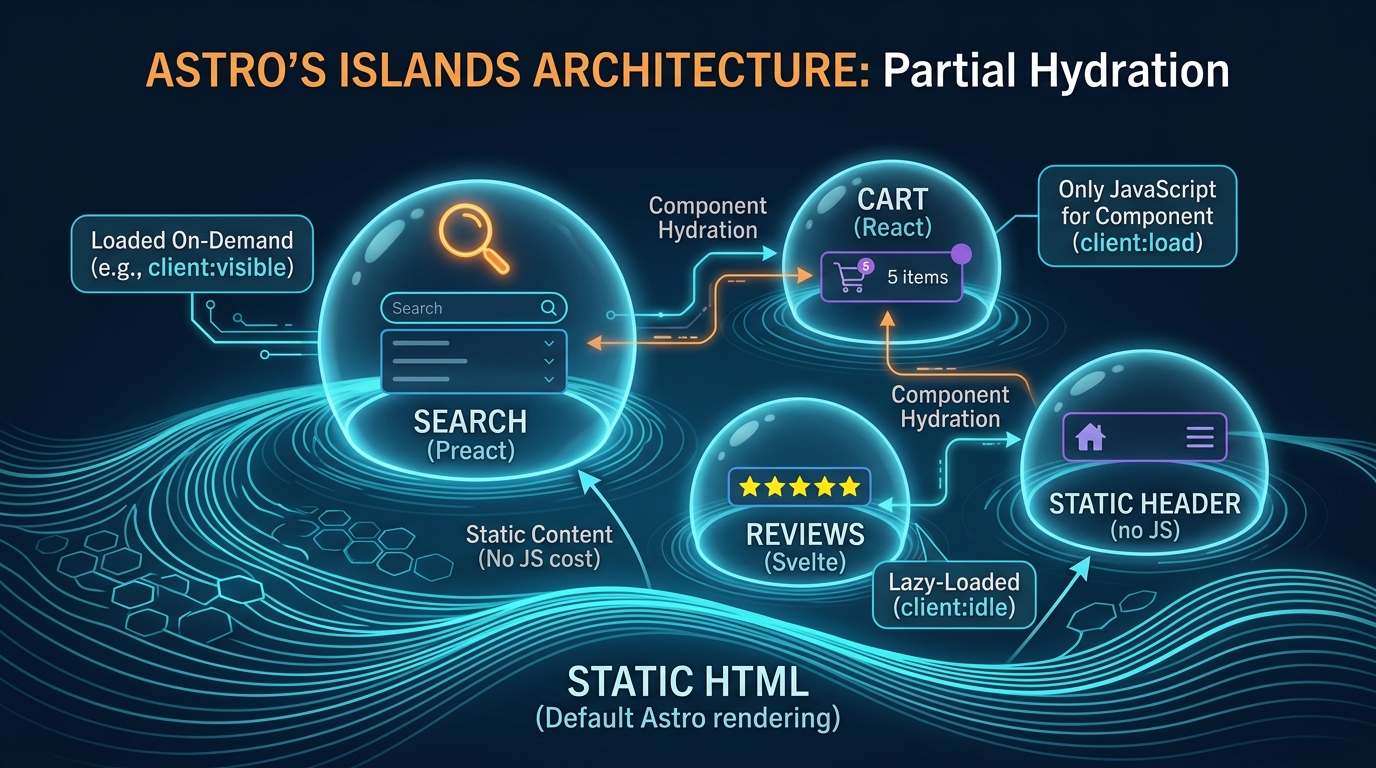
Astro is a modern web framework that pioneered “Island Architecture.” Instead of rendering your entire page using heavy JavaScript frameworks on the client side, Astro pre-renders everything into lightweight, static HTML and CSS during the build process.
Think of it like a printed catalog. The text and images are already there when you open the page—no waiting for the browser to “construct” the page.
But what about interactive elements like a complex search bar, a dynamic pricing calculator, or a shopping cart? This is where the “Islands” come in. Astro treats these interactive components as isolated islands of functionality within a sea of static HTML. It only loads the exact JavaScript required for that specific island, and nothing else.
This means you get the best of both worlds: the lightning-fast load times of a static site and the rich interactivity of a modern web app.
Zero JavaScript by Default
Because Astro generates lean, pre-rendered code, the initial page load is practically instantaneous. We consistently achieve sub-second (< 0.8s) initial loads.
Flawless 95–100 Google PageSpeed Scores
By stripping out unnecessary runtime code, Astro sites natively align with Google’s Core Web Vitals. This drives better organic SEO visibility and maximizes the ROI of your paid campaigns.
Bulletproof Security and Edge Delivery
With Astro, your website is compiled into static assets and deployed directly to global Edge CDNs (like Vercel or Cloudflare). There is no server continuously running PHP. There is no public database to exploit. It is practically immune to the SQL injections and cross-site scripting attacks that plague WordPress.
Near-Zero Operating Overhead
Because static files are served from a CDN with nodes around the world, your marketing site can effortlessly handle viral traffic spikes. A sudden surge of 100,000 visitors won’t cause server slowdowns or generate surprise hosting bills; the CDN simply delivers the static files.
Comparing the Architectures
| Metric | Legacy WordPress Service | MaxStack Astro SSG Solutions |
|---|---|---|
| Mobile Google PageSpeed | 45 – 70 | 95 – 100 |
| Security & Vulnerabilities | High risk (DB & plugins) | Immune to common server/DB exploits |
| Time to First Byte (TTFB) | 0.8s – 2.5s | < 0.1s globally on Edge |
| Traffic Spike Resilience | Needs heavy caching / bigger VPS | Infinite seamless CDN scaling |
| Maintenance Burden | High (frequent plugin breakage) | Minimal (durable, zero fragile dependencies) |
How Teams Migrate Without Losing SEO
One of the biggest fears surrounding a platform migration is the potential loss of SEO rankings. Years of organic growth can evaporate if a migration is mishandled. At MaxStack, our migration process is highly structured to protect and enhance your SEO equity.
- Comprehensive Content Mapping: Before writing any code, we map every single URL, image asset, and metadata tag on your existing site.
- 1-to-1 URL Preservation: Wherever possible, we maintain the exact URL structure of your old site.
- Rigorous 301 Redirects: For URLs that must change, we implement precise server-level 301 redirects to ensure link equity is passed to the new pages without interruption.
- Data Extraction: We extract your existing content from the WordPress MySQL database using automated scripts and convert it into clean Markdown or a modern Headless CMS (like Sanity or Strapi).
- Pre-Launch Auditing: We use tools like Ahrefs and Screaming Frog to crawl the staging Astro site, ensuring there are no broken links, missing canonical tags, or degraded meta descriptions.
Far from losing rankings, most of our clients see an increase in organic traffic post-migration simply because their Core Web Vitals scores improve so dramatically.
Should We Migrate? Practical Guidance
While we are completely convinced of Astro’s superiority for performance-driven websites, migration requires an investment of time and resources. How do you know if it’s time for your business?
You should strongly consider migrating to Astro if:
- Your primary goal is lead generation, B2B sales, or conversion optimization.
- You are spending significant budget on digital ads and cannot afford high bounce rates.
- Your engineering team is spending more time fixing WordPress updates than building new features.
- Your site has suffered security breaches or performance downtimes during critical campaigns.
You might want to stay on WordPress (for now) if:
- You run a massive editorial publication (like a daily news site) with hundreds of writers heavily trained on a highly customized WordPress editorial workflow.
- Your business relies on a very specific, proprietary WordPress plugin that has no API equivalent or modern alternative.
What this means for our clients
- New Projects: All new corporate websites (WebXpert) and high-converting landing pages (LandingX) are built exclusively on Astro SSG.
- WordPress Migration Support: For businesses ready to leave legacy tech behind, MaxStack provides seamless migration services.
- Our Honest Angle on WPPro: We are officially sunsetting WPPro for new inquiries. However, we will continue to maintain and support our existing WordPress clients. We honor our contracts and understand that not every business is ready to migrate today. We simply won’t take on new technical debt.
Build smarter with MaxStack
Our core philosophy is simple: Build Smart, Grow Together. Sunsetting WordPress allows us to deliver the fastest, most reliable web solutions on the market without compromising on quality or maintainability. We are engineers, not just theme installers, and we believe in building on architecture that scales.
Is your current website feeling slow, vulnerable, or holding back your marketing campaigns? Talk to our engineering team for a free performance assessment.

Comments & Discussion
0Your email address will not be published.
No comments yet. Be the first to share your perspective!